
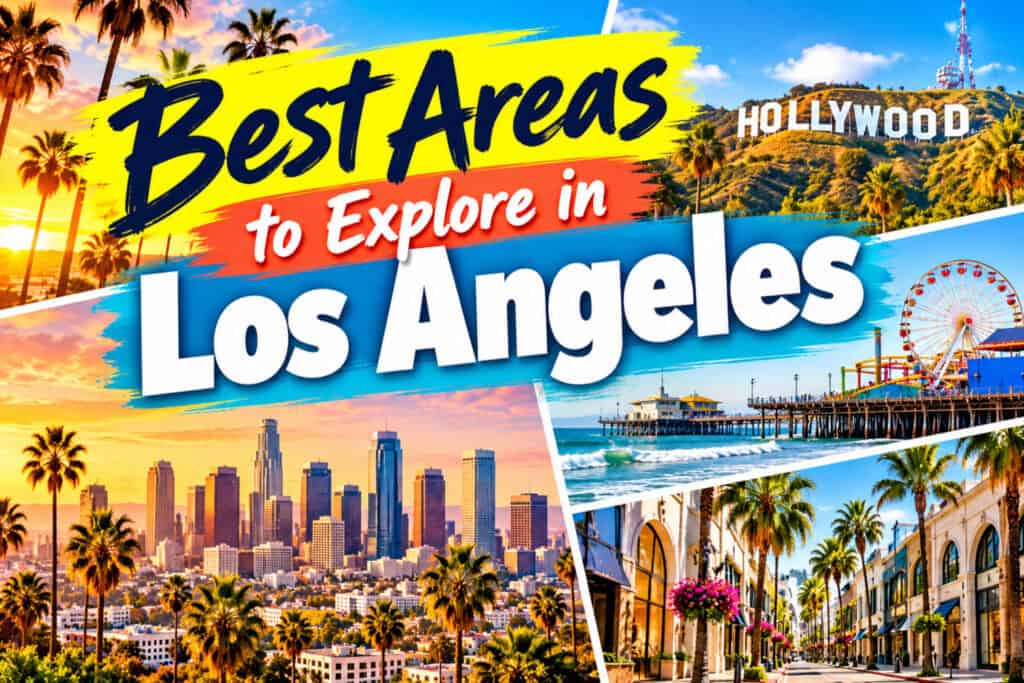
The best areas to visit in LA depend on what you want to see: Hollywood makes sense for a short encounter with movie history, Santa Monica for a classic Pacific pier, and Downtown Los Angeles for architecture and cultural streets.
These are distinct outings, not stops on one convenient pedestrian route.
For a first trip, pick one compact visitor core, then add a nearby area only if the connection fits your day.
The common mistake is treating the Los Angeles map like a single sightseeing district.
Famous names can be miles apart, and a neighborhood that works beautifully on foot may still be awkward to reach without a car.
Decide whether you want a coast day or an inland day before choosing individual stops.
This comparison covers the City of Los Angeles and selected nearby Los Angeles County destinations.
Santa Monica, Beverly Hills, Burbank, and Pasadena are separate cities.
East Los Angeles and Marina del Rey are unincorporated county communities.
Quick picks for visiting LA
Choose a walkable visitor core for the experience it delivers. The limitations matter as much as the attractions.
| Visitor priority | Area | What you actually see | Main downside or limitation |
|---|---|---|---|
| First-time film landmarks | Hollywood | Walk of Fame stars and theater facades | More compelling as a short stop than an entire day for many visitors |
| Classic beach and families | Santa Monica | Historic amusement rides and broad oceanfront | Crowded tourist core; pier-bridge construction can affect access |
| Skateboarding and street life | Venice Beach | Ocean Front Walk, skate plaza, and beachfront activity | Busy boardwalk rather than a quiet shore |
| Architecture and layered history | Downtown Los Angeles | Bradbury Building, Little Tokyo, and historic streets | Pick a subdistrict; Downtown is too big for one casual stroll |
| Music history and after-dark plans | West Hollywood | Sunset Strip music-venue facades | No rail station on the Strip; performances need checking |
| Public art and fossils | Mid-City and Museum Row | Urban Light and outdoor La Brea excavation areas | Tar Pits indoor museum closed as of October 2026 |
| Local park and hillside character | Silver Lake, Echo Park, and Los Feliz | Lotus-filled lake, reservoir paths, and Griffith views | Separate cores with different hills and transfers |
| Working-film-studio experience | Burbank | Ticketed backlot tour at a working studio | Advance booking and a substantial time commitment |
| Historic streets without a beach detour | Pasadena | Old Pasadena's preserved commercial blocks | Separate inland excursion from coastal LA |
| Distinct port-city outing | Long Beach | Rainbow Harbor waterfront and aquarium district | A destination in its own right, not a quick Santa Monica add-on |
Hollywood, Downtown, and central LA
In central LA, visitor sights occupy specific streets and campuses, not entire municipal boundaries.
Hollywood
The Walk of Fame's sidewalk stars create a recognizable film-history photo stop.
Completed in 1961, the original Walk of Fame sits among theater facades along Hollywood Boulevard.
Allow about 45 to 90 minutes for that core if you chiefly want photographs.
For a working backlot, choose Burbank. Hollywood Sign viewpoints and Griffith Observatory require separate travel.
West Hollywood and the Sunset Strip
The Sunset Strip belongs to the separate city of West Hollywood, away from Hollywood Boulevard.
The roughly 1.6-mile stretch preserves a rock-club identity visible in venues such as Whisky a Go Go, which opened in 1964.
Allow about 1 to 2 hours to walk a selected segment, longer for a performance.
Choose it for music history or a specific night out, but skip it if you only want Walk of Fame stars.
There is no Metro Rail station directly on the Strip.
Downtown Los Angeles (DTLA)
A five-story skylit atrium with ornate ironwork makes the 1893 Bradbury Building an unusually tangible piece of Downtown architecture, although access to the interior can be limited.
Nearby Historic Broadway gives a different street-level picture of the old commercial city.
Little Tokyo preserves Japanese American history; the Arts District reuses industrial streets.
Allow about 2 to 4 hours within one Downtown cluster, with more time for museums.
Little Tokyo pairs with the Arts District, though all Downtown sights are not one walk.
Beverly Hills
Beverly Gardens Park's lily pond and Beverly Hills sign provide a public-space counterpoint to the designer storefronts on Rodeo Drive.
Palm-lined facades make this an outdoor streetscape visit even without shopping. Roughly 45 to 90 minutes suits the park-and-Rodeo core.
Skip it if retail architecture and recognizable street scenes hold little interest.
Beverly Hills is a separate city; Wilshire/La Cienega station is not at Rodeo Drive.
Mid-City: Fairfax, Melrose, and Museum Row
Urban Light, the outdoor LACMA installation of 202 restored cast-iron streetlamps, is one of the area's clearest sights without committing to a full museum visit.
La Brea Tar Pits adds genuine Ice Age fossil history within an urban park, including outdoor excavation areas.
As of October 2026, the Tar Pits indoor museum is closed for renovation, so do not plan around seeing indoor displays.
Allow about 1 to 3 hours for a focused Museum Row visit; Fairfax and Melrose extend the walking geography.
The D Line Extension opened a Wilshire/Fairfax station in May 2026, improving access to this core.
Koreatown
Chapman Plaza's Spanish Baroque Revival arcades surround a courtyard designed for an early drive-through market in 1929.
It is an architectural stop within a neighborhood shaped by Korean and Latino communities, rather than a monumental-sight district.
Allow 45 to 90 minutes for a focused Wilshire-area walk. Pair Koreatown with Mid-Wilshire by subway rather than rushing to the beach.
Northeast neighborhoods and inland extensions
Northeast Los Angeles rewards neighborhood walks, while farther inland attractions can justify separate trips.
Silver Lake, Echo Park, and Los Feliz
Restored lotus beds draw walkers to Echo Park Lake, while Silver Lake Reservoir has a quieter public path.
Los Feliz provides access toward Griffith Observatory, opened in 1935, where the city spreads out below the hilltop terraces.
Observatory admission is free; telescope access depends on conditions and schedule.
Allow about 1 to 2 hours for a lake or reservoir outing, or roughly 1.5 to 3 hours at the observatory, excluding travel.
The districts are separate walks; Griffith's hill and parking need their own plan.
Pasadena
A historic district of 22 blocks gives Old Pasadena a more coherent walking experience than many sprawling LA neighborhoods.
Colorado Boulevard storefronts and One Colorado courtyards make the preserved architecture visible without a museum ticket.
Allow 1.5 to 3 hours in Old Pasadena, possibly adding its civic area.
The A Line reaches Pasadena, although the station-to-destination walk still matters. Do not squeeze it into a beach-focused half-day.
San Fernando Valley and Burbank
Warner Bros. Studio Tour Hollywood visits working production space in Burbank, a separate Valley city.
Working exterior sets and the Stage 48 experience are a far more direct production encounter than Hollywood's sidewalk stars.
Reserve about 3 hours on-site, following the operator's guided and self-guided format, and check tickets and age conditions beforehand.
The Valley is extensive; Studio City and Burbank are not one walk.
Glendale and La Canada Flintridge
In Glendale, Brand Park's dome-and-arch Brand Library dates to 1904 and rewards visitors interested in unusual civic architecture.
Descanso Gardens, across the municipal boundary in La Canada Flintridge, is a large botanical-garden visit rather than an add-on around the same block.
Choose one as an inland detour; they share no pedestrian center.
East Los Angeles
Unlike Boyle Heights inside the city, East Los Angeles sits in unincorporated LA County.
Belvedere Community Regional Park has a recreational lake and skate facilities, making it a local outdoor stop rather than a replacement for Downtown's landmark circuit.
Choose a specific local destination rather than a tourist circuit.
The coast, Westside, and studio streets
Coastal days differ by terrain and activity. A busy amusement pier and a bluff trail demand different plans.
Santa Monica
The Santa Monica Pier dates to 1909, with a 1916 hippodrome and rides overlooking the ocean.
The Route 66 End of the Trail marker commemorates a traditional symbolic endpoint, not the exact historical highway terminus.
Allow roughly 1.5 to 3 hours for the pier and nearby oceanfront, or longer for a beach day.
The E Line serves Downtown Santa Monica, simplifying a car-free coastal trip.
The pier remains open during bridge reconstruction, although entry routes and the familiar entrance sign may change.
Check the official access update before going.
Venice Beach
Ocean Front Walk, often called the Venice Boardwalk, extends more than two miles past a skate plaza and beachfront sports facilities.
That public, improvisational character makes it a stronger choice for skaters and people-watching than for silence.
Plan about 1 to 2 hours for the main boardwalk and extra time if you want the canals.
Venice pairs with Santa Monica, but walking the whole corridor takes longer than one beach stop.
South Bay beach towns
Manhattan Beach and Hermosa Beach provide a different coastal outing from Santa Monica. Redondo Beach extends the route south.
The Strand links sections of their waterfront, and Hermosa's current pier dates to 1965.
Allow 2 to 4 hours in one or two adjacent towns rather than every beach community.
Torrance and Palos Verdes lie in the broader South Bay, but need separate transfers.
Choose the South Bay for a walk or bike-oriented beach day, not a quick addition to Malibu.
Malibu
The coastal bluff trail and ocean overlook at Point Dume are the attraction here: Malibu's cliffs and headlands feel markedly different from an urban boardwalk.
Malibu Lagoon provides birdwatching, while nearby Adamson House preserves distinctive Malibu Potteries tile from a 1929 house.
Allow 2 to 4 hours for a lagoon or bluff visit, plus travel. Access can involve grades and stairs.
As of October 2026, Point Dume's lower parking area was inaccessible because of the Westward Beach Road closure; check California State Parks for current access before setting off.
Westside: Westwood, Brentwood, and Sawtelle
Getty Center requires a timed-entry reservation even for free general admission.
Its hilltop tram, travertine architecture, galleries, and Central Garden make Brentwood a proper art excursion, not a quick stop off a Westwood sidewalk.
Allow 2 to 4 hours on campus; Westwood is a separate stop.
Some Getty gallery areas were under renovation in October 2026, and the Center has announced a planned closure from March 15, 2027 to spring 2028.
Check the museum directly before committing to the outing.
Culver City
Sony Pictures' studio lot supplies a ticketed walking-tour option, while the Wende Museum focuses on Cold War-era material in another part of Culver City.
Downtown Culver City merits a 1 to 2 hour walk.
A studio tour needs advance planning, and As of October 2026, Wende galleries are closed, with reopening scheduled for November 7; verify access before visiting.
The E Line reaches Culver City, but studios and museums need last-mile checks.
Marina del Rey
The marina's harbor water, rather than surf, defines this unincorporated community.
Burton W. Chace Park reaches out into the main channel on a peninsula, with walks beside the boats.
Choose it for harbor scenery, perhaps after Venice, rather than ocean surf.
South LA and the harbor cities
A particular cultural site or harbor attraction gives these southern destinations a purpose.
Their distance from the familiar Hollywood-to-coast circuit makes a separate outing sensible.
South Los Angeles
Leimert Park Village's historic theater architecture and cultural spaces offer a neighborhood-scale encounter with African American arts and history.
The area's development began in 1928, and a walk around Leimert Plaza and Degnan Boulevard can fill roughly 1 to 2 hours before a specific cultural stop.
Watts Towers is another important South LA destination but requires a separate transfer and access check.
South Los Angeles spans many communities; it should never be treated as a single walking district or confused with the separate city of Compton.
Long Beach
Rainbow Harbor and Shoreline Village form a waterfront core in the separate city of Long Beach.
The Aquarium of the Pacific is another anchor.
The Queen Mary has been docked in the harbor since 1967, giving the city an unusually visible maritime landmark.
Allow roughly 2 to 4 hours for a chosen waterfront walk, and longer if the aquarium is part of the visit.
The A Line connects Long Beach with central LA, but this is no quick add-on to a Malibu coastal drive.
San Pedro
At the City of Los Angeles' southern harbor edge, Point Fermin Park has coastal bluff paths and nearby heritage sites, including the Korean Friendship Bell.
Choose San Pedro when harbor history and an ocean-facing park are worth a dedicated southward trip.
Long Beach across the harbor is a separate destination, not a continuous waterfront walk.
Inglewood
SoFi Stadium's guided, ticketed tours can take visitors through normally restricted areas such as the player tunnel and locker rooms.
That makes Inglewood worthwhile for a stadium-specific visit, especially for sports fans, rather than as a default neighborhood stroll.
Check tour dates and event-day transport in this separate city.
How the main LA areas compare
Familiar names mask different experiences. Compare them before selecting an outing.
| Actual alternatives | Choose the first when | Choose the other when | Trade-off |
|---|---|---|---|
| Santa Monica vs Venice Beach | You want a historic amusement pier and straightforward E Line access | You want skate culture and a long, busy boardwalk | Both are coastal, but the core experience differs |
| Santa Monica vs South Bay towns | You have limited coastal time and want the classic pier | You want linked shorefront walking or cycling across beach towns | South Bay generally deserves its own coastal outing |
| Venice Beach vs Malibu | Street activity and beachside facilities are the attraction | Cliffs, lagoons, and bluff overlooks matter more | Malibu has greater road and trail-access friction |
| Hollywood vs West Hollywood | Walk of Fame stars and theater photos are the goal | Sunset Strip's music history is the draw | The two places are separate, with a ground transfer between them |
| Hollywood vs Burbank | A short, mostly outdoor celebrity-history stop is enough | A working backlot tour is the priority | Burbank requires tickets and more time |
| Downtown vs Mid-City | You want historic architecture, Little Tokyo, and urban streets | You want public art and Ice Age excavation sites | Museum Row access and exhibition closures can change the choice |
| Downtown vs Pasadena | You prefer contrasting city subdistricts | You want a concentrated historic commercial district | Pasadena is an inland extension, despite rail access |
Area pairings that make geographic sense
Good pairings follow neighboring districts or one transit corridor, with travel time checked separately.
| Base or interest | Logical area pairing | Why it works | Bad combination or detour warning |
|---|---|---|---|
| Beach promenade | Santa Monica + Venice Beach | A shared coastal walking and biking corridor | Do not treat Malibu as the next block south |
| Downtown arts | Little Tokyo + Arts District | Neighboring Downtown cores with different street character | Avoid adding a distant beach before a fixed museum appointment |
| Public art and Wilshire streets | Museum Row + Koreatown | Rail stations connect the broader corridor | Verify the last walk to each chosen entrance |
| Hollywood photography | Walk of Fame + central boulevard theaters | Sights share a compact visitor strip | Griffith Observatory is a separate hilltop transfer |
| South Bay coast | Manhattan Beach + Hermosa Beach | Linked Strand waterfront portions | Malibu or Santa Monica is a different coastal commitment |
| Pasadena architecture | Old Pasadena + nearby civic streets | A coherent inland walking core | Do not splice a Malibu trip into the same short outing |
| Harbor culture | Long Beach waterfront + East Village | Both belong to a focused Long Beach visit | San Pedro is not joined by a continuous pedestrian waterfront |
Practical planning: transportation, access, and time
Metro Rail serves selected corridors, but stations may be far from the sight itself. On-site estimates below exclude travel time and lines.
| Situation or constraint | Most workable area | Check or limitation | Planning action |
|---|---|---|---|
| No car, classic first sights | Downtown, Hollywood, Santa Monica | B Line serves Hollywood, E Line serves Santa Monica, and Downtown connects several routes | Check station maps and walking distance from each platform |
| Museum Row by rail | Mid-City / Wilshire-Fairfax | D Line Extension opened Wilshire/Fairfax in May 2026; service alerts can change access | Verify current D Line service and museum entrances |
| Sunset Strip without a car | West Hollywood | Bus or other ground transfer needed; no station on the Strip | Check last-mile connections before planning a late return |
| Working studio backlot tour | Burbank or Culver City | Tickets, tour length, and age requirements vary by operator | Reserve the studio tour first, then build the area visit around it |
| Timed-entry reservation | Getty Center, Brentwood | Free general admission still requires a reserved entry time; future closure announced | Confirm the date and available reservation on Getty's site |
| Outdoor excavation rather than indoor fossils | La Brea Tar Pits, Mid-City | Indoor museum closed as of October 2026; some outdoor areas remain visitable | Check current park and excavation access before traveling |
| High coastal bluff or limited mobility | Malibu / Point Dume | Trail grades, stairs, and lower-lot road closure can restrict access | Consult the state park's accessibility and road notices |
| Family waterfront outing | Santa Monica or Long Beach | Pier rides and aquarium entry have separate fees and conditions; the pier remains open during bridge work | Choose rides versus aquarium first, then allow a half-day if needed |
| Easy historic walk | Old Pasadena or selected Downtown blocks | Historic districts are more compact than the surrounding city | Allow about 1.5 to 3 hours in Old Pasadena, or 2 to 4 in a Downtown cluster |
| Quieter harbor views | Marina del Rey | Marina walkway differs from a sandy surf beach | Choose Burton W. Chace Park over a surf-beach stop |
| Current gallery or attraction status | Culver City / Wende, Getty, Santa Monica Pier | Renovations and site construction can affect what is actually accessible | Consult the operator shortly before visiting |
| Larger outer-area detour | Malibu, Long Beach, Pasadena, or San Pedro | Each is a separate geographic commitment | Assign the trip a dedicated outing rather than fitting it between central stops |
Questions about visiting LA neighborhoods
Is West Hollywood the same place as Hollywood?
No. West Hollywood is a separate city that includes the Sunset Strip, while Hollywood Boulevard and the Walk of Fame are in Los Angeles.
Their names are similar, but visiting both involves a transfer.
Is East Los Angeles another name for Boyle Heights?
No. East Los Angeles is an unincorporated LA County community.
Boyle Heights sits within the City of Los Angeles east of the LA River, and its visitor experience should be planned separately.
Can I see the main LA neighborhoods without renting a car?
Yes, for a carefully limited set of areas along Metro Rail and connecting buses.
Hollywood and Downtown have rail service, as does Santa Monica. Parts of the Wilshire corridor are also rail-connected.
Malibu and the Sunset Strip need more ground-transport planning.
So do scattered Valley stops. Check current service and the final leg to each destination.
Choose the day's geography first
Give the coast its own outing or choose one walkable inland core.
Add a distant stop only for a particular sight, and let Los Angeles geography shape the day.
Sources
- Discover Los Angeles: Guide to Downtown: Background on Downtown's subdistricts, historic sights, and walking areas.
- LA Metro: Maps and schedules: Current rail and bus routes, stations, and service planning.
- Los Angeles County: Unincorporated areas: Geographic distinctions between cities and county communities.
- Santa Monica: Visiting the Pier: Pier attractions and updates affecting visitor access.
- Los Angeles Recreation and Parks: Venice Beach: Ocean Front Walk and public beachfront facilities.
- Visit West Hollywood: Sunset Strip: Music-history locations and Strip geography.
- La Brea Tar Pits: Hancock Park: Museum renovation status and outdoor activities.
- Getty Center: Plan your visit: Timed reservations, gallery access, and official modernization updates.
- California State Parks: Point Dume: Trail, parking, and coastal access conditions.
- Warner Bros. Studio Tour Hollywood: Burbank backlot tour format and ticket planning.