
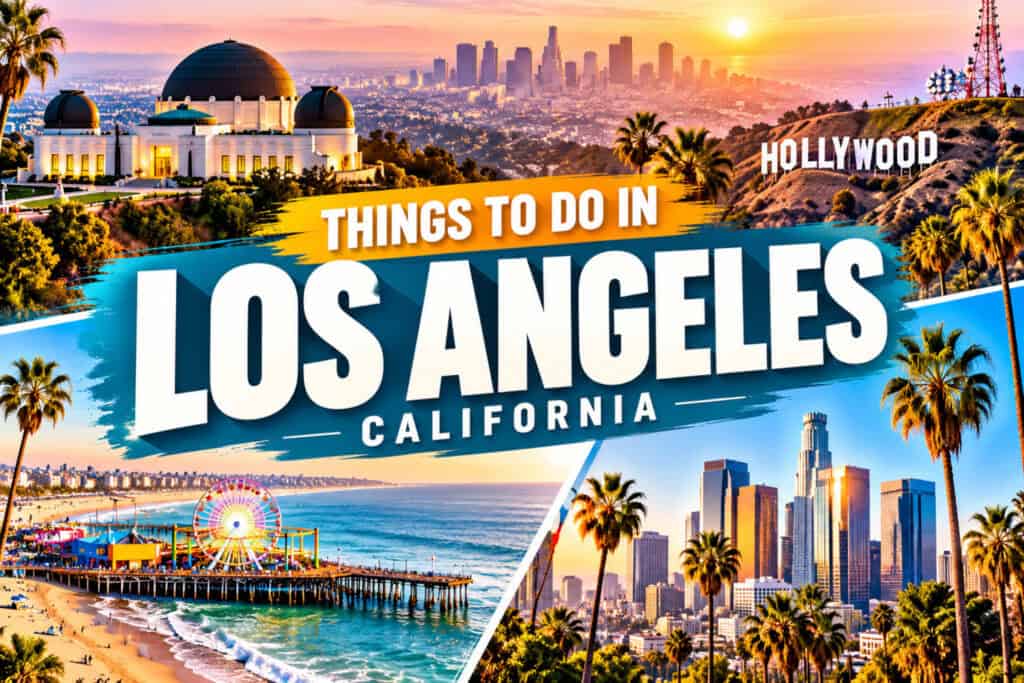
Among the most rewarding things to do in Los Angeles are Griffith Observatory for skyline views and astronomy, the Getty Center for art and gardens, and Venice Beach for street life beside the ocean.
Each belongs to a different part of the city. Los Angeles works best in geographic clusters, rather than as one packed sightseeing checklist.
Film fans may prefer spending most of a day at Universal Studios Hollywood, just outside city limits.
Decide which part of LA matters most to you, then reserve your essential timed ticket before arranging the rest.
A sidewalk star can be a satisfying short stop, but it cannot substitute for seeing a working studio or a serious film collection.
Likewise, a free museum may require advance entry arrangements and paid parking.
The interesting choices involve what happens after you arrive, not simply how famous a place looks on a map.
This covers the City of Los Angeles, with a few clearly marked nearby-city attractions that visitors routinely consider. Disneyland, in Anaheim, is a separate destination.
Quick picks for a first trip to Los Angeles
Choose by the experience you want. Times are approximate on-site allowances, excluding travel and lines.
| Your priority | First choice | Why choose it | Allow on site |
|---|---|---|---|
| First-time skyline and Hollywood Sign views | Griffith Observatory | City panorama, astronomy exhibits, and a view toward the sign without a hike | 1 to 2 hours |
| Art, architecture, and gardens | Getty Center | Hilltop galleries and a landscaped Central Garden | 2.5 to 4 hours, plus arrival |
| Beach street life | Venice Beach Boardwalk and canals | Skaters and performers, followed by quiet canal bridges | 1.5 to 3 hours |
| Classic celebrity photo stop | Hollywood Boulevard | Walk of Fame stars and TCL Chinese Theatre forecourt | 30 to 75 minutes |
| Free contemporary art | The Broad and nearby Grand Avenue | Collection galleries beside Walt Disney Concert Hall's steel curves | 1.5 to 3 hours |
| Art across cultures | LACMA | New David Geffen Galleries and the outdoor Urban Light installation | 2 to 3 hours |
| Movie rides and a studio tram | Universal Studios Hollywood | The Studio Tour plus theme-park attractions; outside LA city | Most of a day |
| Illustration, comics, and cinema imagery | Lucas Museum of Narrative Art | A new museum devoted to visual storytelling in Exposition Park | 2 to 3 hours |
| Family science without a theme-park ticket | California Science Center | Ecosystems galleries and a large kelp forest tank | 1.5 to 3 hours |
Views, gardens, and art above the city
Griffith Observatory is the stronger short choice for a city panorama; the Getty Center rewards visitors prepared to give art and landscape several hours.
Their distant hillside settings make combining both with a downtown museum a demanding day.
Griffith Observatory and Hollywood Sign viewpoints
Griffith Observatory pairs city viewpoints toward the Hollywood Sign with astronomy exhibits and public telescopes that make the 1935 hilltop building a science stop as well as a lookout.
An optional planetarium show costs extra. Its white domes overlook the city's street grid. General building and grounds admission is free.
Authorized terraces and other Hollywood-area viewpoints allow a photograph of the sign without hiking.
The fenced letters cannot be approached or touched, and clouds can obscure the view.
Trails require more time and careful attention to heat, weather conditions, and posted restrictions.
Plan on 1 to 2 hours for exhibits and views, longer for a show or hike. Summit parking is limited and paid, with possible road controls.
The accessible DASH Observatory shuttle connects to Metro's B Line at Vermont/Sunset.
Hollywood can fit into the outing, but Getty and the coast should not be squeezed into the same short day.
Skip this stop if you expect to stand beside the sign.
Getty Center
At the Getty Center, a tram lifts visitors past hilltop terraces to art galleries and Robert Irwin's Central Garden, where water flows through a landscaped azalea maze.
A waterfall and circular planting design reward visitors who might otherwise focus only on paintings.
Opened in 1997, the complex makes architecture and landscape part of the reason to come.
General admission is free, but a timed-entry reservation is required, and parking costs extra.
Metro bus 761 reaches the lower entrance; accessible routes are provided on site. Budget 2.5 to 4 hours plus arrival and tram time.
Art and garden lovers can give it half a day, preferably with other Westside plans.
Skip it when your schedule only permits a quick photo before a distant downtown appointment.
Beach life and Hollywood's famous sidewalk
Venice is a place to watch LA's outdoor culture unfold; Hollywood Boulevard is a shorter pilgrimage to names and images from the screen.
Neither should be confused with a studio tour or a full beach-resort day.
Venice Beach Boardwalk and canals
In Venice, a skatepark borders the busy beachfront Boardwalk, where performers gather near the outdoor Muscle Beach gym and people watch activity along the shore.
Nearby residential canals crossed by pedestrian bridges feel remarkably different.
The waterways trace back to Abbot Kinney's Venice of America development in 1905.
Choose Venice for beach walks and that canal contrast rather than a uniformly quiet shore.
Set aside 1.5 to 3 hours to see both areas. Watch for bikes and uneven or restricted routes around canal bridges.
Santa Monica Pier, in an independent neighboring city, suits a longer coastal outing rather than a hurried Venice add-on.
Hollywood Boulevard, Walk of Fame, and TCL Chinese Theatre
Find the Walk of Fame star for an actor or musician you care about using the official directory, then look at the TCL Chinese Theatre facade and handprints in its forecourt.
Sidewalk stars began appearing in 1960; the theatre's celebrity cement imprints date to 1927.
They are different traditions, visible within a short street walk.
A quick visit takes about 30 to 75 minutes unless you attend a screening.
Crowded sidewalks and paid garages make aimless wandering less appealing.
Choose a film museum or studio tour instead if you want to understand how movies are made.
A permitted Hollywood Sign viewpoint may fit nearby, but the boulevard is not a studio backlot.
Downtown contemporary art and Museum Row
The Broad pairs contemporary museum galleries with downtown architecture. LACMA, in Miracle Mile, is the broader collection choice.
The Broad and Walt Disney Concert Hall
On Grand Avenue, the Broad's honeycomb facade faces Frank Gehry's folded stainless-steel concert hall, so the architecture becomes part of the downtown art outing before you enter a gallery.
The Broad's museum galleries include contemporary works by artists such as Basquiat and Murakami, opposite Walt Disney Concert Hall.
The hall's exterior is rewarding without a performance; a self-guided audio tour inside depends on event access.
Broad general admission is free, and reservations are recommended, though standby entry may be possible.
Yayoi Kusama's Infinity Mirrored Room needs a separate free timed ticket and may be unsuitable for enclosed-space or flashing-light sensitivities.
Allow about 1.5 to 3 hours for the galleries and architecture.
Stay around Grand Avenue, or choose LACMA for art spanning more periods and cultures.
LACMA and Urban Light
Outside LACMA, a grid of vintage streetlamps creates a walk-through artwork.
Chris Burden's Urban Light stands near the David Geffen Galleries, opened April 19, 2026, in a raised building displaying art across periods and cultures.
As of October 2026, the new galleries are open, although specific exhibitions and admission arrangements warrant checking.
Allow about 2 to 3 hours inside and extra time for the outdoor installation.
Nearby Academy Museum and La Brea outdoor spaces pair geographically, but choose how much museum time you can handle.
Metro's D Line extension began serving Wilshire/Fairfax on May 8, 2026.
The Academy Museum advises that this station will close October 23 to November 1, 2026, so check Metro service alerts for those dates.
An Urban Light photograph is a brief outdoor stop; touring LACMA's collection is a different commitment.
Movie worlds and a newly opened museum
Universal Studios Hollywood fills a substantial part of the day with rides and its backlot tram, while the Lucas Museum rewards close looking at art and design.
Their experiences and locations are sufficiently different that they should be chosen separately.
Universal Studios Hollywood
Universal's Studio Tour tram passes working backlot locations and film scenes, including Jaws and the Jupiter's Claim set.
Its approximately 60-minute ride is only part of a paid theme park with movie-based attractions.
Allow most of a day rather than treating the tram as the whole visit.
Book the intended admission date and confirm ride height and accessibility rules for your group.
Universal City lies outside the incorporated City of Los Angeles.
Film-production enthusiasts uninterested in rides may prefer Warner Bros. in Burbank.
Skip the park on a short day already dedicated to the coast or downtown.
Lucas Museum of Narrative Art
The Lucas Museum's curving building in Exposition Park holds illustration, paintings, comics, and film design.
Opened September 22, 2026, it includes the inaugural Star Wars in Motion exhibition, but the wider collection traces storytelling across media and cultures.
Allow about 2 to 3 hours, checking the timed-entry ticket policy before travel.
Choose it for narrative art rather than rides or a working soundstage.
The nearby Science Center can extend an Exposition Park visit, reached by Metro E Line at Expo/Vermont.
Universal City should be treated as a separate outing.
Seven more stops that suit a particular trip
Choose these shorter stops when a specific interest calls for them. Santa Monica Pier and Warner Bros. sit outside LA city.
Santa Monica Pier and Pacific Park (Santa Monica)
A solar-powered Ferris wheel turns over Santa Monica's amusement pier, where a seaside coaster and Pacific views create a different scene from the Venice Boardwalk.
At Pacific Park, in the independent city of Santa Monica, entry is free but rides require tickets.
The classic pier scene suits visitors who enjoy amusements, not those seeking solitude on the sand.
Allow about 1 to 2 hours at the pier, more for a coast day with Venice.
Metro E Line reaches Downtown Santa Monica, followed by a walk to the waterfront.
Academy Museum of Motion Pictures
Film costumes and production artifacts fill the Academy Museum's Stories of Cinema galleries beside its sphere-shaped theater complex.
Choose this over Hollywood Boulevard for substantial film history, not an active soundstage tour.
The operator suggests about two hours; LACMA pairs well nearby. Admission is paid, and screenings or special experiences cost extra.
As of October 2026, its East Rolex Gallery is closed from October 19 to December 12, so confirm which exhibits are available.
La Brea Tar Pits and Hancock Park
The outdoor Lake Pit's asphalt and Project 23's active fossil-research spaces reveal Ice Age remains inside LA.
As of October 2026, the indoor Page Museum remains closed for renovation after July 6, 2026.
An outdoor visit does not guarantee seeing excavators at work.
Allow about 30 to 60 minutes as a Museum Row addition; skip this stop if you want indoor fossil galleries.
El Pueblo, Olvera Street, and Union Station
El Pueblo's plaza contains the 1818 Avila Adobe near Olvera Street, whose marketplace was organized in 1930 and presents a different layer of early Los Angeles life.
Union Station nearby adds its grand rail concourse to this compact history walk.
Allow about 1 to 2 hours for a history walk and any open interiors.
Museum hours vary, and this compact route is no substitute for the region's fuller Indigenous and multicultural history.
Little Tokyo and the Arts District
Japanese American landmarks in Little Tokyo reflect a community history that includes World War II displacement.
Nearby converted buildings and public art belong to the more spread-out Arts District.
As of October 2026, the Japanese American National Museum pavilion is closed, with reopening planned for January 23, 2027.
Allow about 1 to 2 hours in Little Tokyo, longer for street exploration beyond it.
Metro's Little Tokyo/Arts District stop helps, but skip an indoor museum visit here until reopening is confirmed.
California Science Center and Exposition Park
An immense kelp forest tank brings living marine ecosystems indoors at the California Science Center, giving families a hands-on alternative to rides in Exposition Park.
The 188,000-gallon tank is part of free permanent science galleries that merit about 1.5 to 3 hours for families; special experiences cost extra.
Pair it with the nearby Lucas Museum if the group has time.
Space Shuttle Endeavour is not on public display as of October 20, 2026; its upright launch-configuration exhibit is scheduled for November 13, 2026.
Visitors coming solely for the shuttle should verify the opening first.
Warner Bros. Studio Tour Hollywood (Burbank)
A guided cart passes Warner Bros.' working production streets before a self-guided Stage 48 section with film and television displays.
The standard tour takes about three hours, roughly one hour guided and two at your own pace. Filming can change the route.
Choose Warner over Universal for production detail rather than rides, but children under five cannot enter.
Reserve a slot and visit Burbank as a separate outing, not as a walk from Hollywood Boulevard.
How to choose between similar LA attractions
Compare what happens inside. A working studio and an amusement park may carry similar film names but offer very different experiences.
| Choose between | Distinguishing experience | Main trade-off | Best fit |
|---|---|---|---|
| Universal Studios Hollywood vs. Warner Bros. Studio Tour | Film rides and a studio tram vs. a guided working-backlot tour | Most of a paid park day vs. an approximately 3-hour tour; Warner does not admit under-fives | Universal for ride fans; Warner for production-curious adults and older kids |
| Universal vs. Academy Museum | Rides and tram scenes vs. costumes, filmmaking artifacts, and cinema galleries | Paid full-day outing vs. shorter indoor film museum | Universal for action; Academy for film history without rides |
| Academy Museum vs. Lucas Museum | Cinema's institutions and artifacts vs. illustration, comics, and storytelling across media | Museum Row vs. Exposition Park; different timed-entry needs | Academy for movie history; Lucas for narrative art and design |
| Getty Center vs. LACMA vs. The Broad | Hilltop gardens and art vs. varied collections vs. contemporary galleries | Getty needs a reservation and longer Westside visit; the museums cover distinct periods and locations | Getty for gardens; LACMA for breadth; Broad for modern art and downtown architecture |
| Venice Beach vs. Santa Monica Pier | Boardwalk skate and street culture plus canals vs. amusement rides over the ocean | Longer coastal transfer between sites; the pier is in a separate city | Venice for street life; Santa Monica for the classic pier scene |
| Griffith Observatory vs. a Hollywood Sign hike | Terrace panorama and science exhibits vs. physical trail effort and changing views | Paid planetarium or parking vs. hiking conditions and heat; neither allows approach to the letters | Observatory for low-effort views; hike for prepared walkers |
Which neighborhoods and outings fit together
LA sightseeing works best by district, not as one cross-city circuit. Treat a second distant cluster as a separate commitment.
| Area or scenario | Anchor stops | Sensible pairing | Do not casually combine |
|---|---|---|---|
| Griffith Park and Hollywood | Observatory viewpoints; Walk of Fame | Observatory and a short Hollywood street stop when transit and daylight work | Getty Center and a coast visit on the same rushed day |
| Downtown / Grand Avenue | The Broad; Walt Disney Concert Hall exterior | Grand Avenue architecture and galleries | A Venice beach walk presented as another downtown stop |
| Museum Row / Miracle Mile | LACMA; Academy Museum; outdoor La Brea | Choose one main museum, then a nearby short stop | Assuming Page Museum indoor exhibits are operating |
| Venice coast | Venice Boardwalk and canals | Santa Monica Pier as a longer coast outing in a separate city | Treating the two waterfronts as identical or immediately adjacent |
| Exposition Park | Lucas Museum; California Science Center | Narrative art and available science galleries, with breaks | Universal Studios as an effortless add-on |
| Universal City and Burbank, outside LA city | Universal Studios Hollywood; Warner Bros. Tour | Choose the film format you prefer, generally as a dedicated outing | Trying both and the coast in one compact day |
| Downtown historic neighborhoods | El Pueblo and Union Station; Little Tokyo | A history-led walk with Metro connections | Assuming all museums and widely dispersed Arts District blocks are open and close together |
Practical choices: tickets, transit, accessibility, and closures
Some free admissions require reservations; some paid tours restrict ages. Check the operator when a particular experience decides the trip.
| Planning obstacle | What is verified | What to do |
|---|---|---|
| Timed-entry reservation | Getty admission is free but requires a reserved time; Lucas is ticketed with timed entry; Broad's Kusama room has a separate allocation | Reserve the hard-to-replace experience first; do not assume a free museum means walk in any time |
| General admission and planetarium show | Observatory grounds/exhibits, Broad collection, and Science Center permanent galleries have free general admission; planetarium, special experiences, or parking can cost money | Decide what you want to see inside before budgeting or booking |
| Parking restrictions | Getty parking is paid; Griffith summit spaces are limited and paid, with busy-period road controls possible | Consider a bus arrival for Griffith and use the Getty arrival guidance for your chosen transport |
| Metro rail and DASH Observatory shuttle | B Line with DASH Observatory bus serves the Griffith approach; D Line serves Wilshire/Fairfax; E Line connects Exposition Park and Downtown Santa Monica | Check route alerts: the Academy Museum lists Wilshire/Fairfax station closed October 23 to November 1, 2026 |
| Accessible route or reduced walking | Observatory has accessible facilities and a bus option; Getty has accessible transport, while sign hikes and canal bridges vary by route | Choose the terrace or accessible gallery route rather than assuming a trail or bridge works for every visitor |
| Children and ride limits | Warner Bros. does not admit children under five; Universal ride height and access rules vary | Confirm the youngest visitor's eligibility before purchasing admission |
| Closures as of October 2026 | La Brea Page Museum and JANM pavilion are closed; the Academy's East Rolex Gallery has a temporary closure | Choose accessible outdoor areas or other museums rather than counting on closed galleries |
| Not-yet-open attraction | Space Shuttle Endeavour's display is scheduled for November 13, 2026 | Verify opening before planning a shuttle-focused visit |
| Sun, heat, and visibility | Hollywood Sign hikes involve outdoor exertion; an overlook cannot promise a cloud-free panorama | Allow a flexible weather window and follow posted trail and access rules |
Questions visitors still ask
Can I see the Hollywood Sign without hiking?
Yes. Griffith Observatory's public terraces and other authorized viewing locations show the sign from a distance.
The letters themselves are fenced, so avoid plans based on driving or walking up to them.
Is Los Angeles practical without a car?
Yes, for a selectively planned visit.
Metro rail and buses serve several museum and neighborhood clusters, though transfers between hills, studios, and the coast can consume a large part of a day.
Choose fewer areas and check the exact transit route for each stop.
How many days should I allow for the main sights?
One day supports one principal district and perhaps a nearby second stop.
With 2 to 5 days, you can devote separate outings to the hills, museums, coast, and a film experience instead of attempting them all together.
Treat those as planning allowances, not timetables.
Pick the day before the attractions
Los Angeles rewards a choice of area before a choice of checklist: decide whether your next day belongs to the hills, the coast, a museum district, or a film experience.
Reserve any required entry time for that area, then add only nearby stops that genuinely improve the day.
Sources
- Griffith Observatory visitor information: Check public access, transit, parking, and planetarium arrangements.
- Getty Center FAQs: Confirm timed-entry admission and arrival requirements.
- The Broad general admission: Check current free admission arrangements and entry options.
- LACMA David Geffen Galleries opening: Read about the new building and its April 2026 opening.
- Universal Studios Hollywood Studio Tour: Check the studio tram experience before choosing a park day.
- Lucas Museum visitor information: Check current gallery tickets, timed entry, and visitor access.
- Pacific Park visitor information: Find Santa Monica Pier ride and access details.
- Academy Museum visitor information: Check museum admission, exhibitions, and temporary limitations.
- La Brea Tar Pits museum closure: Confirm the indoor museum's status and which outdoor experiences remain available.
- El Pueblo history: Read about Olvera Street, the historic plaza, and the Avila Adobe.
- Japanese American National Museum renovation information: Verify the pavilion reopening date before expecting indoor galleries.
- California Science Center ecosystems exhibits: Find the permanent science galleries available to visitors.
- Warner Bros. Studio Tour Hollywood: Review the Burbank studio tour experience and booking options.
- Metro D Line extension project: Check rail service affecting Museum Row and current transit planning.