
Indiana's best market runs on Tuesdays and Wednesdays. Its most unusual geology is usually at its most exposed from August through October.
Its grand hotel tours happen at 2 p.m., 4 p.m., and noon, Tuesday through Saturday, and only from June through December.
Show up in the same places on the wrong day and you get the parking lot, the river, and a lobby. The calendar does more work here than the map does, and this autumn it is doing extra.
The Children's Museum campus closes for most of September, Mount Baldy's summit is off limits even though the beach below it reopened, Brough's Tunnel at Clifty Falls is closed indefinitely, and storm damage has taken trails at Indiana Dunes and Miller House in Columbus out of the picture for now.
Geography still decides the shape of the trip.
Indianapolis is the strongest base for museums, motorsports, art, and a walkable urban weekend.
The Lake Michigan shore belongs to a separate northern trip built around dunes and beaches.
Brown County and Columbus combine forested hills with unusually strong modern architecture.
Turkey Run has the state's most distinctive ravine hiking, while southern Indiana shifts again into caves, Ohio River landscapes, fossil beds, and grand resort history.
A three-day trip that tries to cover Indianapolis, Indiana Dunes, Brown County, and French Lick will spend too much of itself relocating.
Start with the experience that matters most, then add places that fit the same region.
The best things to do in Indiana at a glance
| Experience | Best for | Region | Time to allow |
|---|---|---|---|
| Indianapolis Motor Speedway Museum | Motorsports, history | Indianapolis | 2-4 hours |
| Children's Museum of Indianapolis | Families, hands-on museums | Indianapolis | Half day to full day |
| Indianapolis Cultural Trail and Downtown Canal | Walking, biking, city orientation | Indianapolis | 2-4 hours |
| Newfields | Art, gardens, mixed-weather days | Indianapolis | 2-4 hours |
| Indiana Dunes National Park | Beaches, dunes, hiking | Northwest Indiana | Half day to full day |
| Shipshewana | Markets, food, rural culture | Northeast Indiana | Half day to full day |
| Columbus architecture tours | Design and architecture | South-central Indiana | 2-4 hours |
| Brown County State Park | Fall color, hiking, scenic drives | South-central Indiana | Half day to weekend |
| Turkey Run State Park | Rugged ravine hiking | West-central Indiana | Half day to full day |
| West Baden and French Lick | Architecture, resort history | Southern Indiana | Half day to weekend |
| Falls of the Ohio State Park | Fossils, geology | Clarksville | 1.5-3 hours |
| Clifty Falls State Park | Waterfalls, hiking, river-town weekends | Madison | 2-5 hours |
| George Rogers Clark National Historical Park | Revolutionary-era history | Vincennes | 1-2 hours |
| Spring Mill State Park | Pioneer history, caves, hiking | Mitchell | Half day |
| Marengo Cave | Guided cave tours | Southern Indiana | 1.5-3 hours |
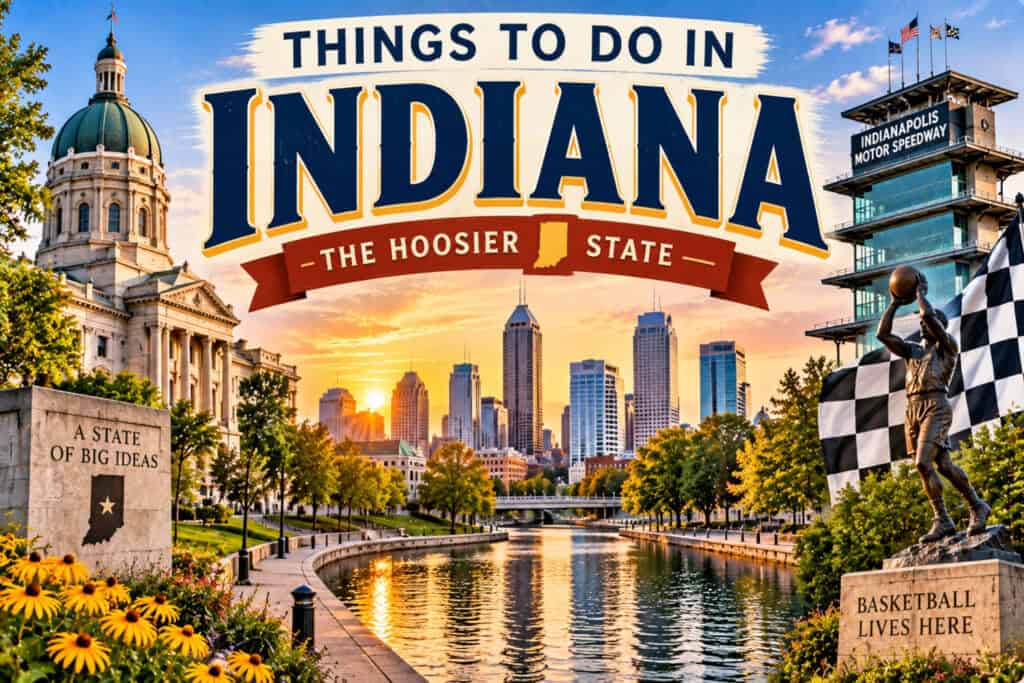
1. See the Speedway Museum and try for a track tour
The Indianapolis Motor Speedway Museum is the clearest place to start if racing is part of the reason for visiting Indiana.
It reopened in April 2025 after a 17-month renovation that substantially expanded the galleries and the visitor experience, and the exhibits now cover drivers, strategy, engineering, Indianapolis 500 history, race-day culture, trophies, and vehicles from the museum's collection.
The track tour is the upgrade worth chasing.
Depending on track activity, tours may include a lap of the oval, the Yard of Bricks, Victory Podium, or other restricted areas.
Museum admission is required for the tour, and the schedule shifts because the Speedway is a working racetrack.
Event weekends are where that bites.
Some 2026 race and practice days require separate Indianapolis Motor Speedway gate admission on top of museum admission, and the usual museum parking arrangements may change.
A half day covers it for casual race fans, and longer if a track tour is running.
2. Give the Children's Museum a full day, and check the September closure
The Children's Museum of Indianapolis works as a destination rather than a short stop between adult-oriented attractions.
General admission includes the indoor museum and, when in season, the outdoor Riley Children's Health Sports Legends Experience.
Indoor exhibits run from dinosaurs and science to history, transportation, art, and role-play spaces, which is why families burn most of a day here without trying.
The 2026 scheduling issue is unusually important.
The entire museum campus is scheduled to close from September 14 through September 25, 2026 for infrastructure work, and Playscape is scheduled to be closed from September 8 through November 6, 2026 for updates.
Anyone visiting Indianapolis around those dates needs another rainy-day plan, and it is worth settling before other fixed-date tickets get bought around it.
3. Use the Indianapolis Cultural Trail as a way to understand downtown
Indianapolis spreads its major attractions across several districts, and the Cultural Trail turns that geography into part of the experience.
The walking and biking route connects downtown cultural districts and public spaces, including areas around Mass Ave, Fountain Square, Indiana Avenue, White River State Park, and the Downtown Canal.
On a first afternoon it does a specific job: it shows how close some Indianapolis neighborhoods and attractions really are, which saves a day of short drives later.
Walk or bike one section, stop for lunch, then continue along the canal or through a nearby district.
Covering the whole network is only worth it when the trail itself is the day's activity.
It is also one of the best no-ticket options in central Indianapolis.
4. Combine art and gardens at Newfields
Newfields is the counterweight to an Indianapolis itinerary dominated by sports and family attractions.
The campus holds the Indianapolis Museum of Art, gardens, and the Virginia B. Fairbanks Art & Nature Park, so galleries carry the visit when the weather turns and the gardens and art park carry it when the weather is good.
The museum and garden keep different hours from the art and nature park, which makes a late-day visit worth checking first.
The art park is generally open from dawn to dusk, while the museum has set daytime and evening hours depending on the day of the week.
For travelers who already have several indoor museums booked, Newfields earns its slot because a visit can move between art, landscape design, and open space instead of staying in galleries for hours.
5. Hike and swim at Indiana Dunes National Park, with current conditions in mind
Indiana Dunes is one of the state's most distinctive landscapes: Lake Michigan beaches backed by dunes, woodlands, wetlands, and prairie.
The national park stretches along roughly 15 miles of shoreline and contains more than 50 miles of trails, so the better version of a visit combines a trail with time beside the lake instead of driving straight to the sand.
In September 2026, route choice matters more than usual.
The National Park Service is still reporting storm-related closures and partial closures on several trail systems, and its current status page recommends West Beach as a dependable option for parking, trails, picnic space, and beach access while repairs continue elsewhere.
Mount Baldy needs its own note.
The access site and beach route reopened in June 2026 after a sand-management project, while the dune face and summit remain closed because of unstable sand and collapse risk.
The reopening does not mean the dune can be climbed.
Indiana Dunes National Park and Indiana Dunes State Park sit next to each other under separate management.
Anyone after the state park's 3 Dune Challenge or its facilities has to check that park's access and fee rules separately, because one set of rules does not cover both.
West Beach is the sensible first national park visit; a second day earns its place if birding, multiple habitats, or longer hikes are the point.
6. Build a Shipshewana day around the market, not around gawking at Amish life
Shipshewana is most useful as a market town and a regional base.
The outdoor Shipshewana Flea Market is the anchor in warm weather, and in 2026 it runs from May 5 through September 30, primarily on Tuesdays and Wednesdays from 8 a.m. to 4 p.m., with selected holiday and weekend dates as well.
That schedule is the whole planning problem.
A traveler who arrives on a random Thursday in summer gets a different town than someone who arrives on a market day.
Beyond the market, the area rewards time given to local food, shops, crafts, and country roads.
The surrounding Amish and Mennonite communities are living religious communities where people are going about their week, so respectful travel matters more than trying to photograph or collect encounters with residents.
A market morning, lunch, and a slower afternoon in the surrounding area is usually enough for a first visit.
7. See why Columbus became an architecture destination
Columbus is one of Indiana's best surprises, because the city's design reputation is wildly disproportionate to its size.
Architecture tours introduce work by designers including Eero Saarinen, I.M. Pei, Robert Venturi, Harry Weese, and others whose buildings and landscapes are scattered through the city.
A guided tour adds the part you cannot see from the sidewalk: how schools, churches, civic buildings, banks, and public spaces became a long-running design culture.
Guided tours regularly sell out, so advance reservations are sensible.
Self-guided options exist for travelers who prefer to walk, bike, or use an audio tour.
One current limitation shapes a 2026 visit.
The Columbus Visitors Center says Miller House and Garden is temporarily closed for restoration because of storm damage, which makes the broader Architecture Highlights and the self-guided options the dependable choices, and a poor idea to build a trip around the house alone.
Columbus pairs naturally with Brown County, since the two run in opposite directions: deliberate modern design in the city, wooded hills and scenic roads next door.
8. Use Brown County State Park as the outdoor half of a south-central Indiana trip
Brown County State Park is Indiana's largest state park and one of its strongest fall-color destinations.
It covers nearly 16,000 acres of ridges, ravines, forest, lakes, hiking trails, mountain-bike trails, scenic overlooks, and winding roads, which means a first-timer can combine one short trail, a lake or overlook, and a scenic drive and still understand why the park is popular.
Fall weekends are the obvious high-demand period, so lodging and camping plans benefit from early reservations.
Nearby Nashville adds shops, galleries, food, and places to stay, so the area works as a weekend rather than only a park day.
RV travelers have a specific rule to know.
The park directs all RVs and vehicles towing trailers to the west gate, because the north entrance uses a historic covered bridge with a 9-foot height clearance and a 3-ton weight limit.
9. Hike Turkey Run for the ravines, ladders, and streambeds
Turkey Run is the Indiana hike to choose when a normal woodland path sounds too tame.
Its most memorable routes run through sandstone ravines where the streambed becomes part of the trail.
Trail 3, the famous Ladders Trail, is rated very rugged and uses ladders between the steep walls of Rocky and Bear hollows.
Other routes cross creeks, climb steps, pass cliff edges, and move through old forest.
Those same features explain why weather matters so much here.
The Indiana Department of Natural Resources warns that sections can become slick, uneven, or impassable during high water, and the ravines are the first thing to go when the water comes up.
As of September 7, 2026, Trail 7 is closed, while Trail 9 has reopened after a long flood-damage closure and ladder reconstruction.
Recent rainfall has left open trails muddy.
Road construction adds another layer: closures on U.S. 41 and State Road 47 have required detours around Turkey Run during summer and September 2026.
An old route description or a saved map is worth less here than the park alert page on the morning you drive.
Families with very young children, pets, and hikers uncomfortable with ladders have good alternatives, and the park explicitly recommends other trails for visitors the ladder routes do not suit.
10. Tour West Baden Springs and French Lick instead of only admiring the lobbies
The neighboring resort towns of West Baden Springs and French Lick are at their best as architectural and social-history stops.
The two landmark hotels sit about a mile apart and preserve the atmosphere of the grand resort era, when visitors came for mineral springs, elaborate public spaces, long stays, entertainment, and spa culture.
Indiana Landmarks runs guided tours that explain the buildings, the restoration work, and the larger resort history.
In the June-through-December schedule, West Baden Springs Hotel tours run at 2 and 4 p.m. Tuesday through Saturday, and French Lick Springs Hotel tours at noon on those days.
Capacity is limited and reservations are strongly recommended.
A traveler with a few hours can tour one hotel.
An overnight works better for anyone who wants the architecture, the resort grounds, dining, and the surrounding Orange County attractions without watching the clock.
11. Time Falls of the Ohio around river levels
Falls of the Ohio State Park is a place where the season changes what is physically visible.
The park protects extensive exposed Devonian fossil beds along the Ohio River in Clarksville, about 390 million years old, and they are one of the state's most unusual outdoor geology experiences when they are actually out of the water.
River level is the variable.
Indiana DNR identifies August through October as the period when the fossil beds are usually most accessible, because the river tends to be lower then.
High water can cover most of what visitors came to see, which makes river conditions more important than the weather forecast.
Exploring the beds is encouraged, and collecting fossils from them and from the riverbank is prohibited.
Separate collecting piles near the interpretive center hold material that visitors are allowed to take.
The park sits directly across the Ohio River on the Indiana side, so it slots easily into a Louisville-area trip.
12. Pair Clifty Falls State Park with Madison
Clifty Falls State Park is the outdoor counterpart to a weekend in Madison.
Trails descend into ravines and approach a series of waterfalls that rise and fall with recent rainfall.
The park is most dramatic when the water is running hard, and the canyon terrain, forest, and Ohio River setting keep it worth the trip in drier stretches.
One 2026 closure changes a popular route.
Brough's Tunnel is closed indefinitely after a spring rockslide and the possibility of more falling rock.
Trail 5 remains open, and visitors are instructed to avoid both tunnel entrances, so an old trail description or a saved map may no longer match what is on the ground.
A half day in the park followed by downtown Madison and the riverfront beats either stop on its own.
13. Put Vincennes on the map for Revolutionary-era history
George Rogers Clark National Historical Park is easy to overlook, because Vincennes sits far from Indiana's biggest tourism hubs.
The park tells the story of Clark's 1779 campaign and the capture of Fort Sackville, a pivotal episode in the Revolutionary-era struggle for the Illinois Country.
The large memorial beside the Wabash River is the visual center, and the visitor center supplies the film, exhibits, and historical context.
The park is free. Outdoor grounds are open from sunrise to sunset, while interior access follows visitor-center hours.
The memorial building is opened on request when staff are available, so checking in with a ranger is part of the visit rather than an optional courtesy.
Vincennes makes the most sense as a history stop on a western or southwestern Indiana road trip, rather than a long standalone detour from Indianapolis.
14. Mix pioneer history and karst landscape at Spring Mill State Park
Spring Mill State Park works because its cultural history and its geology are the same story.
Cave springs supplied the reliable water that helped support an early industrial village, and the park now combines the restored Pioneer Village, nature interpretation, forest trails, cave-related features, and the Grissom Memorial.
The range is wider than a standard hiking stop.
Families can move between historic buildings and outdoor trails, while anyone interested in geology can see how springs and caves shaped settlement and industry in one walk.
Some programs, including cave-related experiences, depend on season and operating conditions, so the day's park schedule is worth checking when a particular interpretive program is the main reason for coming.
Spring Mill also sits well inside a broader southern Indiana itinerary with French Lick, West Baden, and cave country.
15. Take a guided walking tour at Marengo Cave
Indiana's cave country deserves at least one underground experience, and Marengo Cave is the easiest to plan around.
It offers two main guided walking tours: the Crystal Palace tour takes about 40 minutes and the Dripstone Trail takes about an hour.
The cave holds around 52 degrees Fahrenheit, so a light layer is useful even when the surface is hot.
For ordinary show-cave visitors, advance reservations are not required, though buying ahead simplifies a busy day.
Accessibility is the bigger decision.
The walking tours include steps and narrow passages and are not accessible to wheelchairs or strollers, which makes Spring Mill's above-ground history and easier park options the better alternative for some groups.
Marengo Cave is open year-round except for limited holiday closures, and that makes it one of the most dependable southern Indiana activities outside peak outdoor season.
When to visit Indiana
Spring suits city trips, Brown County hiking, Turkey Run, and southern Indiana, although heavy rain can make ravine trails slick or temporarily impassable.
Summer is strongest for Lake Michigan, the Shipshewana market, outdoor Indianapolis activities, and long park days.
Beach visitors should still check Lake Michigan weather, wave conditions, and rip-current information before swimming.
Fall is the classic Brown County season and also works well for Turkey Run, Clifty Falls, Columbus, and road trips through southern Indiana.
Popular weekends around peak foliage can fill lodging and campgrounds early.
Winter shifts the advantage toward Indianapolis museums, Newfields, hotel architecture in French Lick and West Baden, and Marengo Cave.
Trails stay possible in many parks, while ice and short daylight change the practical difficulty.
How to choose the right Indiana trip
For a first Indianapolis weekend, two or three days can combine the Speedway Museum, the Children's Museum or Newfields, and a Cultural Trail or canal walk.
The city has enough range that a distant state park only makes sense on a longer trip.
For Lake Michigan, center a northwest Indiana trip on Indiana Dunes rather than dropping in between Chicago and somewhere else.
Current trail closures make a flexible plan especially useful this year.
For design plus fall scenery, Columbus and Brown County form one of the state's most coherent pairings.
Architecture fills one day; forest drives, overlooks, hiking, and Nashville fill the next.
Fall is spectacular and busy in equal measure.
For a rugged hiking weekend, Turkey Run can carry a full outdoor day on its own.
Nearby state lands and Parke County extend the trip, with current trail and road alerts shaping the route.
For southern Indiana, a French Lick, West Baden, Spring Mill, and Marengo trip works over several days, because those places share a south-central geography and offer completely different days: resort architecture, pioneer history, forest, caves, and underground tours.
A separate Madison, Clifty Falls, and Falls of the Ohio trip fits southeastern Indiana and the Louisville corridor better.
The Indiana calendar in 2026
| Dates | What they govern |
|---|---|
| May 5 - September 30, Tuesdays and Wednesdays, 8 a.m. to 4 p.m. | The outdoor Shipshewana Flea Market season, plus selected holiday and weekend dates |
| June - December, Tuesday to Saturday | Indiana Landmarks hotel tours: West Baden at 2 and 4 p.m., French Lick at noon |
| Since June 2026 | Mount Baldy's access site and beach route are open again; the dune face and summit are not |
| August - October | The window when the Falls of the Ohio fossil beds are usually most exposed |
| September 8 - November 6 | Playscape closed at the Children's Museum |
| September 14 - 25 | The whole Children's Museum campus closed |
| Year-round, 52 degrees Fahrenheit | Marengo Cave, minus limited holiday closures |
Most of those windows are open right now, and one of them shuts the Children's Museum campus later this month.
Marengo Cave is the only line on the list that reads the same in January as in July.
Sources and further reading
- Indianapolis Motor Speedway Museum - Plan Your Visit
- The Children's Museum of Indianapolis - Plan Your Visit
- Indiana Dunes National Park - Current Status and Updates
- Columbus, Indiana - Architecture Tours
- Shipshewana - 2026 Flea Market Schedule
- Indiana DNR - State Park Advisories and Closings
- Indiana Landmarks - French Lick and West Baden Hotel Tours
- Indiana DNR - Falls of the Ohio State Park
- National Park Service - George Rogers Clark National Historical Park
- Marengo Cave - Walking Tours