
"Swamp tour" is the phrase most Louisiana trips get built around, and it covers four genuinely different days: a boardwalk you walk, a paddle you steer, a motorboat somebody else drives, and a marsh you look at through a windshield.
Each takes a different amount of planning. The phrase tells you none of that. Louisiana does this repeatedly. Cajun and Creole get sold as one flavor of culture and describe two different histories.
A plantation visit can mean a mansion or a museum built around slavery, depending entirely on which site you pull into.
Most of the planning work here is choosing which version of a thing you want, and the labels won't make the choice for you.
The geography is the easy part. New Orleans is the strongest first stop for jazz history, Creole architecture and dense urban sightseeing. Acadiana shifts a trip toward Cajun music, cooking and smaller communities.
The Atchafalaya and the coastal refuges turn it toward wetlands and wildlife, while central and northern Louisiana add pine forest, archaeology and the Cane River landscape.
For a first trip of five to seven days, the most rewarding balance is usually New Orleans plus Acadiana, with one carefully chosen wetland day.
The 10 stops, and where each one sits
| Stop | Best base or region | Time to give it | Best for |
|---|---|---|---|
| French Quarter and jazz history | New Orleans | 1-2 days | First-time visitors, architecture, music |
| Barataria Preserve | Greater New Orleans | Half day | Easy wetland access without a boat |
| Atchafalaya wetlands | Between Baton Rouge and Lafayette | Half to full day | Paddling, boating, birding, more time inside the swamp |
| Lafayette and Eunice | Acadiana | 1-2 days | Cajun culture, music, food |
| Avery Island | Near New Iberia | Half day | Food history, gardens, scenic driving |
| Creole Nature Trail and Cameron Prairie | Southwest Louisiana | Full day | Wildlife, coastal marsh, road-trip scenery |
| Whitney Plantation | River Road | Half day | Slavery-centered plantation history |
| Cane River Creole National Historical Park | Natchitoches area | Half to full day | Plantation landscapes, Creole history |
| Poverty Point | Northeast Louisiana | 2-4 hours | Archaeology and monumental earthworks |
| Kisatchie National Forest | Central and north Louisiana | Half to full day | Hiking, camping, lakes and pine forest |
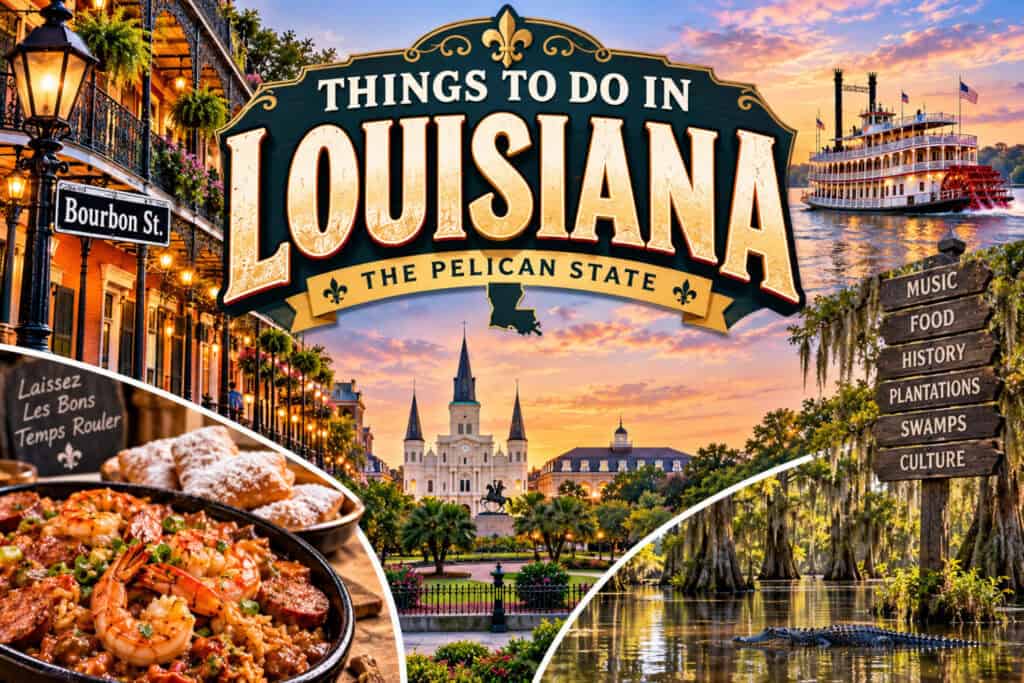
New Orleans: the Quarter in daylight, the music after dark
The French Quarter is an efficient first introduction to Louisiana because so many layers sit within walking distance: French and Spanish colonial planning, Creole architecture, the Mississippi River, Jackson Square and a long musical history.
The National Park Service describes the Vieux Carre as the historic core of New Orleans and keeps a French Quarter visitor center on Decatur Street.
Give the neighborhood daylight as well as evening time.
In daylight, the architecture, courtyards, riverfront spaces and the signs explaining them are easier to notice.
After dark, the emphasis shifts toward live music and dining, and the Quarter stops being a synonym for Bourbon Street.
New Orleans is widely recognized as the birthplace of jazz, and the New Orleans Jazz National Historical Park exists specifically to explain the music's origins, early development and continuing presence in the city.
Its visitor center is most useful for travelers who know they want "New Orleans music" without yet knowing how jazz, brass-band traditions and the city's neighborhoods connect.
Use that context when picking a music night.
A venue where the musicians are the main event gives you a different evening from a bar where music runs behind the conversation, and one strong live set beats collecting several famous streets before midnight.
Food works the same way, once geography gets attached to it.
Gumbo, jambalaya, crawfish, boudin and po'boys are familiar names, and where you eat them changes what they mean.
New Orleans is an especially strong place to explore Creole food traditions shaped by a long mix of European, African, Caribbean, Native and later immigrant influences, which makes a two-region trip more interesting than eating the same Louisiana sampler in four towns.
"Swamp tour" covers four different days, and Kisatchie isn't one of them
The right wetland choice depends on how you want to move through the landscape, not on which outing is most famous.
| How you see it | Best fit | What you gain | Main tradeoff |
|---|---|---|---|
| Boardwalk or trail | Barataria Preserve | Easy access, quiet observation, no boat required | Smaller radius and weather exposure |
| Paddle or small boat | Atchafalaya region | Time deep in the bayous and cypress-tupelo swamp | More dependence on weather, water conditions and navigation |
| Guided motorized boat | South Louisiana wetlands | Broader reach, with a guide explaining it | More tour-like and less quiet |
| Auto wildlife route | Cameron Prairie / Creole Nature Trail | Flexible pace, good for families of all ages | Wildlife viewing depends on season, weather and luck |
| Forest trail | Kisatchie National Forest | A completely different Louisiana ecosystem | Not a swamp at all |
For a first trip, Barataria plus one Atchafalaya boat or paddle outing is enough wetland variety.
Stacking several similar boat tours rarely improves a trip as much as giving that time to Acadiana, history or another landscape.
Barataria Preserve, for a wetland day without a boat
Barataria Preserve, part of Jean Lafitte National Historical Park and Preserve, protects more than 26,000 acres of hardwood forest, swamp, bayous and marsh near New Orleans.
Trails and wildlife viewing make it one of the easiest ways into the landscape, and it suits families, travelers who would rather skip a motorized tour, and anyone with only half a day outside the city.
It also teaches you enough about the place to make a later boat or paddle trip mean more.
Rain, heat and trail conditions change the feel of a visit quickly.
In warm months, early outdoor time is more comfortable than building the day around a midday walk.
The Atchafalaya, for a day inside the wetland
Atchafalaya National Wildlife Refuge protects more than 15,000 acres of bottomland hardwood forest and bald-cypress-tupelo swamp roughly between Baton Rouge and Lafayette, with waterways and forest that support boating, paddling, birding, fishing and hiking.
A paddle or guided boat outing reaches environments a boardwalk cannot, and the price is more planning: water conditions, weather, navigation and seasonal hunting activity all matter.
Land-based visitors have hiking access, and the Fish and Wildlife Service specifically notes hunting-season visibility precautions.
These are working public lands rather than manicured parks.
Cameron Prairie and the Creole Nature Trail, for wildlife by road
Southwest Louisiana offers a third way to do it: wildlife viewing from the driver's seat.
Cameron Prairie National Wildlife Refuge, about 25 miles southeast of Lake Charles, includes freshwater marsh, coastal prairie and former rice fields.
Its visitor facilities and auto-tour route are the main way visitors get in, and the refuge is part of the Creole Nature Trail.
The route works for groups with small children, for people who would rather not board a boat, and for travelers folding wildlife into a longer drive.
It also swaps the wooded swamp most visitors picture for open marsh, prairie and Gulf-influenced country.
A full southwest Louisiana day feels different from both New Orleans and the Atchafalaya, which is why it earns a place only when the itinerary has room for it.
Kisatchie, which is not a swamp at all
Kisatchie National Forest is Louisiana's only national forest, and the U.S. Forest Service manages more than 604,000 acres of it across five ranger districts in central and northern Louisiana.
Depending on the district, recreation includes hiking, camping, lakes, biking, horseback riding and off-highway vehicle trails.
Longleaf pine landscapes, upland forest and lakes look nothing like the Atchafalaya or the coastal refuges.
Kisatchie is too large and dispersed to treat as one attraction.
Pick a ranger district or a named trail system before you drive there.
It pays off most for travelers already moving through central or north Louisiana, or on a trip built around the outdoors.
Wildlife, wherever you go, is never guaranteed.
A good wetland day still works when the value comes from the habitat, the birds, the water, the trees and what you learn about them, rather than from a close alligator photo.
Cajun and Creole are related, and they are not the same trip
Travel marketing collapses Cajun and Creole into a single flavor of Louisiana culture, and that costs you one of the state's most useful distinctions.
Cajun identity grew from Acadian migration and adaptation in south Louisiana.
Acadians were expelled from Acadie in the 18th century, and some eventually settled here, adapting over generations to new landscapes and interacting with Native peoples, free and enslaved people of African descent, Creoles and other immigrant communities.
The people and traditions that emerged became what we now recognize as Cajun culture.
Creole has carried several meanings over time and has referred to diverse Louisiana communities shaped by French and Spanish colonial society, people of African descent, Caribbean connections, Native influences and later social change.
The two have interacted for centuries and both keep changing. Neither substitutes for the other.
The distinction changes a trip in practical ways. New Orleans is particularly strong for Creole urban history.
The prairies and bayous west of the Atchafalaya are where Cajun history and living traditions are easiest to meet, and Cajun cooking there developed from Acadian settlement and adaptation to the prairies, bayous and wetlands of south Louisiana.
Cane River, farther north, adds another Creole story, including Creoles of color and plantation communities in central Louisiana.
Lafayette, Eunice and the prairie communities
Lafayette is the obvious urban base for Acadiana, and the most interesting cultural day reaches past the city.
Eunice, the smaller prairie communities and the bayou corridor are what connect music, language, dancing, food and Acadian history to actual places.
As of September 2026, the National Park Service's Acadian Cultural Center in Lafayette is temporarily closed because of air-conditioning problems.
The Prairie Acadian Cultural Center in Eunice is the strong Park Service alternative and is normally open Tuesday through Saturday, except federal holidays.
Its programs focus on prairie Cajun history and can include music, dance, food and crafts.
Closures like this change, so check before you go.
Avery Island, for hot sauce and a drive-through garden
Avery Island makes a natural half-day side trip from the New Iberia area, tying Louisiana hot-sauce history to a distinctive south Louisiana landscape.
Jungle Gardens adds a drive-through public garden to the same stop, which turns the visit into a food-history-and-landscape detour rather than a conventional factory tour.
It belongs inside an Acadiana itinerary.
The value comes from connecting it with New Iberia, bayou country or another south Louisiana stop on the same day, not from driving out from New Orleans for it.
A plantation visit depends entirely on which plantation
Plantation landscapes are part of Louisiana history, and what a visit means depends on how the site explains slavery, forced labor, family life and the economic system that produced the architecture and the wealth.
Whitney Plantation is notable because its museum puts slavery and enslavement at the center.
For a traveler choosing one River Road plantation, that focus makes it the most direct place to meet the human history behind the landscape.
Cane River Creole National Historical Park, near Natchitoches, takes a broader landscape approach through its Oakland and Magnolia units.
The National Park Service explains slavery, plantation agriculture, Creole culture, the Civil War, sharecropping and later changes in rural life across both.
Most visitors need roughly one to two hours for each unit and three to four hours to see the pair.
Cane River's guided tours are currently by appointment, and the park asks visitors to request them at least two weeks ahead.
Self-guided access is available on regular opening days.
This is one of the Louisiana stops where reading the official schedule before building the route prevents a wasted detour.
Natchitoches goes back to 1714, Poverty Point goes back 3,000 years
Natchitoches dates to 1714 and is the oldest permanent settlement in Louisiana.
Its historic district and Cane River setting make it the natural base for the Cane River Creole sites nearby, and it comes as a change of pace after south Louisiana, layering French colonial history, Caddo trade routes, Creole communities, plantation agriculture and later American development into a smaller-city setting.
A day in town plus a second half-day or full day for Cane River holds together better than treating the plantations as isolated roadside stops.
Poverty Point pushes much further back.
In northeastern Louisiana, the site preserves monumental Native American earthworks spread across more than 400 acres.
At its height roughly 3,000 years ago it was part of a trading network that reached a long way beyond it, and its mounds and ridges represent an enormous investment of organized labor.
The museum, guided programs and self-guided routes all work toward understanding the earthworks and the society that built them.
Poverty Point is worth the drive into northeast Louisiana when archaeology is a real interest.
As a hurried add-on to a New Orleans weekend it fails, because what the site gives back has no relationship to the hours of driving it takes to reach.
Best time to visit, and what hurricane season actually costs you
Louisiana works year-round, and the best season depends on what the trip is built around.
Late winter through spring is one of the easiest periods for combining cities, outdoor time and cultural events.
Days are generally more comfortable for walking than in midsummer, and south Louisiana's festival calendar is active.
Summer works for travelers who can tolerate heat and humidity and are willing to push outdoor time into the cooler parts of the day.
Indoor museums, long meals and evening music become bigger parts of the rhythm.
Fall can be excellent for outdoor trips, and it overlaps with Atlantic hurricane season.
The official Atlantic season runs from June 1 through November 30, activity peaks on average around September 10, and most of it concentrates from mid-August through mid-October.
A trip in those months isn't a bad idea; it's a trip where flexible plans and current forecast checks matter more.
Winter suits urban sightseeing and many outdoor areas, particularly for travelers who don't need swimming or hot weather.
Holiday schedules can change national park and cultural-center hours.
For any trip during hurricane season, refundable or changeable lodging does more for you than trying to predict storm risk months out.
Near departure, National Hurricane Center forecasts and local closure notices matter more than historical averages.
How many days Louisiana needs
Three days: New Orleans only. Enough for a satisfying first visit if the itinerary stays concentrated.
One day for the French Quarter and riverfront, one for deeper music and neighborhood exploration, and one for a museum, a food-focused day or Barataria Preserve.
The mistake at this length is adding Lafayette to say you saw more of the state, because the hotel change and the road time cost too much of a short trip.
Five days: New Orleans plus Acadiana.
Roughly three days in New Orleans and two around Lafayette, with one of the driving days absorbing a wetland or food-history stop.
Five days is the shortest trip where the difference between Louisiana's regions becomes visible, and the two halves feel meaningfully different without forcing a statewide loop.
Six or seven days: add one more region.
Keep New Orleans and Acadiana, then pick one extension: the Atchafalaya plus the southwest marshes for wetlands and wildlife, River Road plus Natchitoches and Cane River for history, Kisatchie for the outdoors, or Poverty Point as part of a north or northeast route.
One addition produces a better trip than an attempt at all four.
In practice that week runs like this.
Days 1 to 3 in New Orleans: walk the French Quarter in daylight, hear live music, spend time with jazz and Creole history, and make meals part of the sightseeing.
Day 4 goes to wetlands, either Barataria for a trail-based day or the Atchafalaya for a paddle or boat, with little reason to attempt both.
Days 5 and 6 are Acadiana, based around Lafayette and reaching into Eunice, New Iberia, Avery Island or another prairie or bayou community.
Day 7 is yours: stay in Acadiana for food and music, return toward New Orleans through a history stop, or start north toward Natchitoches.
Ten days or more: a statewide road trip.
Ten days makes room for New Orleans, Acadiana and at least two more regions without every day turning into a drive.
A coherent loop can take in south Louisiana, the southwest coast, central Louisiana and Natchitoches, with Poverty Point added if archaeology is a priority.
At this length the state stops being a set of day trips from New Orleans.
What Louisiana doesn't promise
Three things a Louisiana trip tends to lean on are the three the state can't commit to.
Alligators show up or they don't, and a wetland day has to be worth the trip on habitat, birds, water and trees alone.
The weather in September is a probability, not a schedule, which is what refundable lodging is for.
And a cultural center can close on a mechanical fault, as the Acadian Cultural Center in Lafayette is right now.
What Louisiana does commit to is the choice.
Four ways into the wetlands, two cultures that overlap without being interchangeable, and plantation sites that differ from one another more than they resemble one another.
Decide which version you came for and the rest of the itinerary mostly builds itself.
Sources and further reading
- National Park Service - Jean Lafitte National Historical Park and Preserve visitor information
- National Park Service - From Acadian to Cajun
- National Park Service - New Orleans Jazz National Historical Park
- U.S. Fish & Wildlife Service - Atchafalaya National Wildlife Refuge
- U.S. Fish & Wildlife Service - Cameron Prairie National Wildlife Refuge
- U.S. Forest Service - Kisatchie National Forest
- National Park Service - Cane River Creole National Historical Park
- National Park Service - Poverty Point National Monument
- National Park Service - Whitney Plantation preservation record
- National Hurricane Center - Tropical Cyclone Climatology