
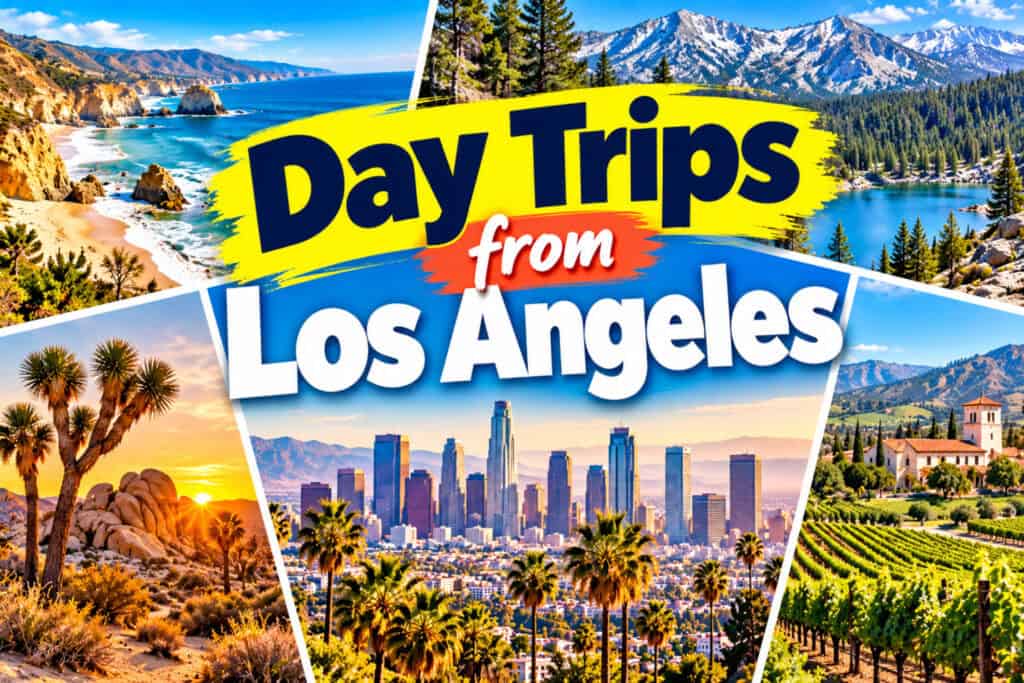
The most rewarding places to go from Los Angeles include Santa Barbara for a coastal train outing and Catalina Island for a harbor reached by ferry.
Joshua Tree rewards desert walkers, while Big Bear Lake trades rock country for pines and mountain air.
The right choice depends less on distance on a map than on how much of your day remains after transportation.
Check the return trip before choosing an island or a long inland trip, and treat summer desert heat and winter mountain roads as reasons to change plans.
The choices here are destinations outside LA's local sightseeing areas, including Catalina despite its location in Los Angeles County.
Quick picks for a day trip or weekend getaway
These choices distinguish a plausible same-day trip from an outing that asks for more time.
Onsite estimates elsewhere in the article exclude travel from Los Angeles.
| Your trip | Choose | Why it fits | Rule it out if |
|---|---|---|---|
| Car-free coastal day trip | Santa Barbara | Downtown Pacific Surfliner arrival puts the beach and historic center within walking reach. | The train's return leaves too little time in town. |
| Rocky beaches and tide pools | Laguna Beach and Crystal Cove | Small coves and protected coastal habitats beat a long city itinerary. | Parking or low-tide timing will be a problem. |
| Island harbor and a walkable town | Catalina Island, Avalon | Boats arrive at a harbor lined with a promenade and historic landmarks. | Ferry fares or the return sailing do not fit. |
| Wild island without town services | Santa Cruz Island, Channel Islands | Boat access leads to trails and a historic ranch landscape. | You need an easy boat landing or shops. |
| Desert rock formations | Joshua Tree National Park | Short, distinctive rock-country walks make a focused park visit possible. | Summer heat or driving commitment is excessive. |
| Desert architecture and alpine views | Palm Springs | Modernist buildings and a tram into the mountains create contrasting sights. | The tram is not operating and it is central to your plan. |
| Forest and lakeshore | Big Bear Lake | A paved lake path offers a lower-effort mountain outing. | Chain controls or snowy road conditions are unsuitable. |
| Historic small-town afternoon | Ojai or Solvang | Arcaded storefronts or Danish-style streets give the walk a clear focus. | You want a strenuous outdoor adventure. |
| Museum-filled weekend getaway | San Diego | Balboa Park and the downtown waterfront deserve more than a quick stop. | You have only a short afternoon. |
Choose a Southern California corridor
For road trips, pick a corridor before adding extra stops.
A second destination can be useful on a longer outing but may turn a relaxed day into a sequence of transfers.
| Corridor | Destinations | Practical pairing | Avoid on a casual same-day trip |
|---|---|---|---|
| North coast and inland valley | Santa Barbara, Ojai, Solvang | Explore Santa Barbara's courthouse and waterfront, or keep Ojai and Solvang as their own town walks. | Promising all three after a train arrival. |
| Orange County coast | Laguna Beach, Crystal Cove | Choose one beach zone, or drive between them if you accept separate parking. | Treating every cove as a quick walk from one lot. |
| Offshore | Catalina's Avalon, Santa Cruz Island | Choose one ferry or boat-based island experience. | Combining both islands in one outing. |
| Desert | Joshua Tree, Palm Springs | Choose rock trails or architecture and an aerial tram. | A full park visit plus a full Palm Springs day. |
| Mountains | Big Bear Lake, Idyllwild | Focus on the lake and pine path, or a forest village and nature center. | Linking both mountain towns as an easy loop. |
| Southbound | San Diego, Temecula | Give San Diego its own city day or visit Temecula's Old Town museums. | Treating both as brief stops from LA. |
Coastal places with a distinct reason to go
A beach day and a historic waterfront town solve different problems.
Santa Barbara rewards walking after a train arrival, while the coves farther south reward checking tides and accepting beach-access logistics.
Santa Barbara: coastal train and a 1929 courthouse
The Santa Barbara County Courthouse has a tiled, Spanish-Moorish facade, a painted Mural Room, and an 85-foot clock tower.
Completed in 1929, the building is a reason to move beyond the waterfront: it gives the city walk a striking architectural centerpiece.
Stearns Wharf and State Street supply an easy contrast of sea views and downtown streets.
Check county courthouse visitor access and tour information before counting on entry to every interior space.
The Pacific Surfliner reaches a downtown station roughly two blocks from the beach, making Santa Barbara one of the clearer car-free choices from LA.
Allow about 4 to 6 hours for the courthouse and waterfront, with State Street between them; train time is extra.
Skip it as a casual side trip if the available service leaves little time ashore.
Adding Ojai or Solvang to a short train day defeats the point of arriving without a car.
Laguna Beach and Crystal Cove: coves, cliffs, and tide pools
Small beaches between rocky headlands shape a visit to Laguna Beach.
The tide pools are part of a protected marine environment, so a low-tide visit means watching animals where they live, never touching or collecting them.
Low tide alone does not make a shoreline safe; wave conditions and posted beach guidance still decide access.
Nearby Crystal Cove State Park preserves a Historic District of 46 coastal cottages dating from the 1930s and 1940s.
That built shoreline is a different experience from Laguna's coves, and the pair works best for travelers willing to change parking areas.
Allow about 3 to 5 hours in one zone, with additional time if combining them.
Families or visitors with limited mobility should investigate Crystal Cove's Los Trancos parking and accessible shuttle rather than assume the slopes and paths are interchangeable.
Islands: Avalon comforts or Santa Cruz self-reliance
An island trip starts with a booked seat and ends with a fixed return sailing. Avalon has town services close to the harbor.
Santa Cruz Island instead requires an organized boat landing and supplies for an independent day.
Catalina Island: a harbor day in Avalon
Avalon's Crescent Avenue curves around a boat-filled harbor, with the Green Pier and the Catalina Casino providing landmarks you can identify as soon as you reach town.
The Casino, built in 1929, contains an Art Deco theater and ballroom; it is a historic entertainment building, not a gambling hall.
A harbor walk can connect a booked Casino visit with one water activity without trying to see every corner of Catalina.
Plan on about 4 to 6 hours in Avalon itself.
Ferries serving Catalina depart from mainland terminals such as Long Beach, San Pedro, and Dana Point, depending on the operator and route.
The transfer from central LA to the correct terminal is a separate leg, and an easy walk in Avalon does not make the entire trip car-free or inexpensive.
Check both the outward ferry schedule and the last suitable return sailing before spending money on activities.
Two Harbors is a different, less-serviced island area, not a neighboring stop on Avalon's promenade.
Santa Cruz Island: trails beyond the boat landing
The mainland boat trip to Santa Cruz Island's Scorpion Anchorage brings hikers to a coast with protected trails, a beach, and remnants of the Scorpion ranch settlement.
The ranch house is a tangible reminder that the island was worked land before its national park role.
Unlike Avalon, there is no ordinary shopping street or dependable place to replace forgotten supplies.
Scorpion has drinking water, but other island landing points can have none.
This Channel Islands National Park outing is for people who would rather walk a trail than tour a town.
A boat from the Ventura area takes about an hour under suitable conditions, but the practical time on the island depends on the operator's actual day schedule.
Plan around roughly 4 to 6 hours ashore only when the sailing allows it.
Boat landing conditions, pier access, uneven paths, and weather can rule out a trip for someone who needs step-free access.
Reserve the boat and bring supplies before considering a hike. Do not substitute Santa Barbara Island as a routine alternative.
As of October 2026, dock damage meant Island Packers was not running scheduled trips there.
Recheck boat access with the National Park Service before considering it.
Desert trips and summer heat
Choose desert walking or a town-and-tram experience first. Joshua Tree brings more direct heat exposure on its trails.
Palm Springs adds tram availability and boarding plans to the drive.
Joshua Tree National Park: rock corridors on short loop trails
Huge rounded monzogranite boulders close around the 1-mile Hidden Valley loop trail, historically associated with cattle rustlers.
Nearby Barker Dam's 1.1-mile loop passes a structure tied to early ranching.
These are specific experiences worth choosing over an ambitious checklist of distant park roads, although short trails can still have rocky footing and exposed stretches.
A focused park visit needs about 4 to 6 hours, excluding the long approach and return.
Pair Hidden Valley with Barker Dam, then consider Keys View only if conditions and daylight leave room.
Joshua Tree is a weak choice for travelers without a car or anyone who cannot safely handle desert heat.
The National Park Service warns about extreme summer temperatures, little shade, patchy cell coverage, and crowded trailhead parking in busy periods.
Stay in designated parking, carry adequate water, and change or cancel exposed walks when conditions demand it.
A full Joshua Tree visit plus a full Palm Springs visit is not a casual single-day combination.
Palm Springs: modernism below an aerial mountain ride
The Palm Springs visitor center occupies a former Albert Frey-designed gas station with a dramatic upswept roof, an immediate example of the city's midcentury-modern design.
The Aerial Tramway adds a second, very different sight: rotating cars travel up Chino Canyon to Mountain Station at 8,516 feet.
The tram opened in 1963, and its high-elevation endpoint can feel far colder than the desert floor.
A road-based visit can pair a selective architecture walk or drive with the tram if it is operating.
Allow about 4 to 6 hours for this limited combination, plus travel from LA and possible boarding lines.
Someone interested mainly in sustained rock scrambling will likely prefer Joshua Tree.
Check the tram operator's operating status, tickets, mountain weather, and return arrangement before setting the day around the ascent.
Mountain forests beyond the city
Mountain weather changes both what you can do and whether the drive is sensible.
A lake path and a smaller forest village are alternatives, not stops on one effortless circuit.
Big Bear Lake: an accessible lakeside walk
The north shore's paved Alpine Pedal Path passes pines and meadows beside views of Big Bear Lake.
At about 2.5 miles one way, it gives walkers, cyclists, stroller users, and many wheelchair users a defined outing without committing to a steep forest trail.
The lake and mountain backdrop provide the change of setting even when winter sports are unavailable.
Set aside about 3 to 5 hours for the lakeshore and a modest village or forest stop.
Big Bear suits someone who wants lake scenery with the option to keep activity gentle; it is less suitable for a driver uncomfortable on snowy mountain roads.
Winter recreation depends on actual conditions rather than the calendar.
Check Caltrans QuickMap for chain controls and snow-chain requirements before departing, and do not assume Idyllwild is a quick addition to the same day.
Idyllwild: a nature center instead of a ski-centered day
A pine-covered village and the Idyllwild Nature Center shift the emphasis to short woodland walks and exhibits about the area's ecology and Cahuilla culture.
The nature center's local trail system makes the town a reasonable choice without a summit objective.
California State Parks also describes the roughly 1-mile Panorama Point loop as a gentler option than strenuous high-country routes.
Set aside about 3 to 4 hours for the nature center and a short forest walk, plus driving.
Pick Idyllwild over Big Bear if the nature-center setting matters more than a lakeshore.
Longer walks in the Mount San Jacinto State Wilderness may require a free day-use wilderness permit, while the Panorama Point loop is treated separately.
Verify park conditions, ice, parking, and permit rules before taking a route beyond the easy walk.
The Palm Springs tram's mountain access does not turn Idyllwild village into a same-day add-on.
Small towns and a larger city worth more time
A short historical main-street visit and a full city weekend require different schedules. Choose the scale before deciding where to stop.
Ojai: an arcade with a local story
The Ojai Arcade's continuous arches frame a walk through the town's commercial center.
Its Libbey-era design and the nearby park give the visit more substance than a generic afternoon of storefronts.
The city designated the Arcade a local landmark in 1993, and its historic walking materials connect the area with the early 20th-century town plan.
Allow about 2 to 4 hours to explore the Arcade and Libbey Park on a compact historic walk.
Ojai is strongest for a slower inland valley afternoon, especially by car.
Skip it if the day's goal is a large museum complex or demanding outdoor activity.
Santa Barbara and Ojai both have appeal, but combining them requires a deliberate longer road day rather than a hurried extension of the Santa Barbara train outing.
Solvang: Danish-style streets near an early mission
Windmills and Danish-style facades distinguish Solvang's small central streets from the California beach towns.
Danish immigrants founded the settlement in 1911, and the nearby Old Mission Santa Ines dates to 1804.
The combination makes the stroll a specific cultural visit rather than a claim that a whole European country has been recreated.
Plan about 2 to 3 hours on foot for the streets and mission area, separate from the drive.
Solvang is better for an architecture-and-history afternoon than a wilderness day.
Travelers trying to add it after a full Santa Barbara visit should allow a longer day or overnight rather than counting on a light detour.
Temecula: Old Town and hands-on local history
Old Town Temecula retains a Western-style streetscape shaped by its former role as a stagecoach stop documented from 1858 and a later rail connection dated to 1882.
The Temecula Valley Museum gives the historic streets a specific interpretive stop.
Pennypickle's Workshop is an alternative hands-on children's museum when its current admission and hours suit the family.
An Old Town walk and one museum visit call for about 2 to 4 hours.
This is a grounded historic-town or family option, not a requirement to book wine tasting.
It has less appeal for someone seeking sea cliffs or rugged backcountry.
San Diego and Temecula make better competing southbound choices from LA than a rushed double stop.
San Diego: make the larger city a weekend getaway
Balboa Park's California Tower rises above a complex of museums and Spanish-style exhibition architecture, built for the 1915 Panama-California Exposition.
The park gives San Diego a tangible cultural focus beyond its waterfront.
For a limited visit, choose a museum and surrounding park walks, or stay downtown near the harbor after arrival.
Attempting the zoo, several museums, beaches, and Old Town in the same short visit is a recipe for mostly getting between places.
Budget about 5 to 7 hours for a selected portion of the city, with 1 to 2 nights the stronger plan for broader exploration.
The Pacific Surfliner serves downtown Santa Fe Depot, with trolley connections for onward travel; check local transit as well as the train home.
San Diego works for a longer museum-and-city escape, not for someone with a spare afternoon and no tolerance for the additional travel.
Choose between destinations that sound similar
Names can make two trips sound interchangeable when their actual days are quite different.
Use the dominant experience and your willingness to manage transport as the deciding criteria.
| Head-to-head choice | Choose the first when | Choose the second when | The trade-off |
|---|---|---|---|
| Santa Barbara vs. Laguna Beach | You want a walkable train arrival, courthouse architecture, and waterfront. | You want coves and tide pools and can manage beach parking. | Historic city walk versus smaller shoreline access points. |
| Santa Barbara vs. Ojai | You want coast, a substantial landmark, and rail access. | You want a quiet inland arcade and short historic loop by car. | Longer downtown waterfront visit versus smaller-town pace. |
| Joshua Tree vs. Palm Springs | Rock formations and short desert trails are the main event. | Modernist buildings and a possible aerial tram ride are the draw. | Exposed park conditions versus ticket and tram-operation dependencies. |
| Avalon vs. Santa Cruz Island | A harbor town and booked water activities sound appealing. | You are prepared for independent trails and limited island services. | Town comfort versus boat-landing demands and self-reliance. |
| Big Bear vs. Idyllwild | A paved lakeshore path and mountain village fit the group. | A nature center and forest walks matter more than a lake. | Winter mountain driving affects both, but their onsite activities differ. |
| San Diego vs. Solvang or Temecula | You have time for a major museum-and-city stay. | You want a compact historic walk and perhaps one museum. | Broad city itinerary versus focused small-town afternoon. |
Practical decisions before you commit
Check the actual return leg, not just the way out.
Transportation and onsite time become especially important when a fixed ferry, train, or mountain-road restriction controls the day.
| Go/no-go factor | Destinations affected | What to check before leaving |
|---|---|---|
| Pacific Surfliner coastal train | Santa Barbara, San Diego | Departure from LA Union Station, destination stop, onward walk or local transit, and usable return service. |
| Ferry schedule and return sailing | Catalina's Avalon | Correct mainland terminal, both sailings, boarding window, and port transfer from LA. |
| Boat landing and pier access | Santa Cruz Island | Island Packers reservation, current landing conditions, weather, walking surfaces, water, and supplies. |
| Summer heat and desert exposure | Joshua Tree, Palm Springs | NPS heat guidance for trails; tram weather and operator status for high elevation. |
| Trailhead parking and designated spaces | Joshua Tree | NPS visitor alerts and crowded trailhead conditions; never park off-road. |
| Snow chains and chain controls | Big Bear, Idyllwild | Caltrans QuickMap, storm and road restrictions, and appropriate vehicle equipment. |
| Tide pools and marine protected areas | Laguna Beach, Crystal Cove | Tide, surf, official access information, and no-touch/no-collection rules. |
| Mobility and accessible shuttle | Crystal Cove, Big Bear, island trips | Los Trancos accessible shuttle, paved Alpine Pedal Path, and whether boat boarding or trails meet your needs. |
| Wilderness permit and trail difficulty | Idyllwild | California State Parks' route-specific permit guidance and trail conditions. |
| Overnight escape versus same-day trip | San Diego, deep Joshua Tree visit, complex boat outings | Whether round-trip transport leaves the minimum useful time onsite before reserving a return. |
Pick the trip that leaves room for the experience
Before choosing a place, check its operating transport or road conditions and work backward from the time you want to spend there.
An enjoyable departure from Los Angeles is defined by the hours you can actually use at the destination, not the shortest-looking line on a map.
Sources
- Pacific Surfliner destinations: Find train destinations and station locations for coastal travel from Los Angeles.
- Santa Barbara County Courthouse history: Check the building's historical details and visitor information before planning an interior visit.
- Catalina Express schedules and fares: Check mainland terminals, departures, and return sailing options.
- Joshua Tree National Park hiking: Read the park's descriptions of desert trails before selecting a short walk.
- Palm Springs Aerial Tramway: Find tramway operating information and high-elevation travel details.
- Big Bear trails: See options including the Alpine Pedal Path and other lakeside or forest walks.
- Crystal Cove State Park: Read about the park's protected coastline and historic cottage district.
- Laguna Beach tide pools: Review tide-pool etiquette and safe wildlife observation.
- Channel Islands National Park visiting information: Check boat access, island services, and trip-planning conditions.
- Balboa Park visitor information: Learn about the historic California Tower and the park's distinctive buildings.