
If you plan to visit just one observation deck in New York City, choose the view you want in your photographs and the kind of experience you actually enjoy - not simply the tallest tower.
Top of the Rock puts the Empire State Building in front of you; the Empire State Building lets you stand inside the landmark itself.
SUMMIT turns the skyline into a mirrored art installation, Edge adds a dramatic outdoor ledge, and One World Observatory looks toward the harbor from Lower Manhattan.
There are also two quite different options: a free, tightly controlled visit to the historic Centre 360 cupola near City Hall, and a paid glass walkway above Times Square. Neither is an interchangeable substitute for a traditional high-rise skyline deck.
For most first-time visitors, one well-chosen paid observatory is enough; a second makes sense when it gives you a genuinely different perspective.
Quick picks: which observation deck fits your visit?
| Your priority | Start with | The reason to choose it - or pass |
|---|---|---|
| A classic skyline photograph with the Empire State Building in it | Top of the Rock | The Empire State Building sits in the view, and the upper terrace is open-air. Pass if an exposed deck is a poor fit. |
| Visiting a New York landmark as well as looking out from it | Empire State Building | Art Deco interiors, historical exhibits, and the 86th-floor terrace. You cannot photograph the full building while standing on it. |
| Mirrored rooms, interactive art, and dramatic photos | SUMMIT One Vanderbilt | Reflections, floating orbs, glass ledges, and a terrace. Pass if crowds, glare, or sensory effects bother you. |
| A high outdoor thrill with a glass floor | Edge | An overhanging triangular terrace and angled glass walls, plus indoor installations. Not ideal for severe height anxiety. |
| An indoor panorama with harbor and Downtown landmarks | One World Observatory | Enclosed views toward the rivers, harbor, and bridges; useful on a Downtown day. Clouds can still hide the scenery. |
| A free, unusual view if a reservation works out | Centre 360 | A small historic civic cupola rather than a commercial tower. Weekday access, height restrictions, and very limited places apply. |
| Looking down into Times Square rather than surveying all of Manhattan | Times Square Skywalk | A glass walkway above the famous intersection. It is a street-scene experience, not a skyscraper-height substitute. |
The five major skyscraper observation decks
Top of the Rock: the Empire State Building belongs in the picture
From the 70th-floor open-air terrace at 30 Rockefeller Plaza, you can photograph the Empire State Building to the south and look toward Central Park to the north.
The experience spans the 67th, 69th, and 70th floors; the highest level has no wall of glass between your camera and the skyline.
This makes Top of the Rock a particularly sensible first paid deck if your mental picture of New York includes the Empire State Building rising among other towers.
The viewpoint has genuine history: the original observation deck opened in 1933 and reopened in 2005 after a long closure.
Newer upgrades play with that heritage.
The Beam lifts seated visitors above the deck in a recreation of the famous 1932 construction-worker photograph, while SKYLIFT raises visitors on a revolving platform.
Those extras are separate choices, not something to assume is included with basic admission.
Allow about 45-75 minutes on the viewing levels, plus entrance and elevator waits; the paid Beam or SKYLIFT experiences need additional time.
Rockefeller Center and nearby Fifth Avenue are natural pairings.
Pick a different deck if you need an entirely indoor visit or care more about interactive rooms than an unobstructed urban panorama.
SUMMIT One Vanderbilt: the skyline becomes part of an art installation
SUMMIT is not primarily a straightforward terrace.
The route through One Vanderbilt's upper floors begins with Kenzo Digital's Air: mirrored surfaces multiply Manhattan's buildings in almost every direction.
Floating reflective orbs appear in another room, and Levitation lets visitors step onto glass-bottomed ledges over Madison Avenue.
On the 93rd floor, an outdoor terrace gives you a more conventional open-air view.
That combination explains both the attraction and its main drawbacks.
SUMMIT rewards people who want photographs of themselves inside an unusual environment, not just clear pictures of distant buildings.
It may be less pleasant for anyone sensitive to bright reflections, immersive sound or light, or busy staged photo areas.
The operator recommends sunglasses in strong daylight, clothing suitable for reflective floors, and shoes that will not damage the surfaces.
The exterior glass elevator, Ascent, is a separate paid upgrade and should not be confused with Levitation.
Allow roughly 90-120 minutes on site as a planning estimate, with more slack for popular arrival windows or an Ascent add-on.
You can enter from the Grand Central area, so the terminal and its surrounding Midtown landmarks make an easy pairing.
Do not squeeze SUMMIT between two fixed appointments merely because the tower looks close to them on a map.
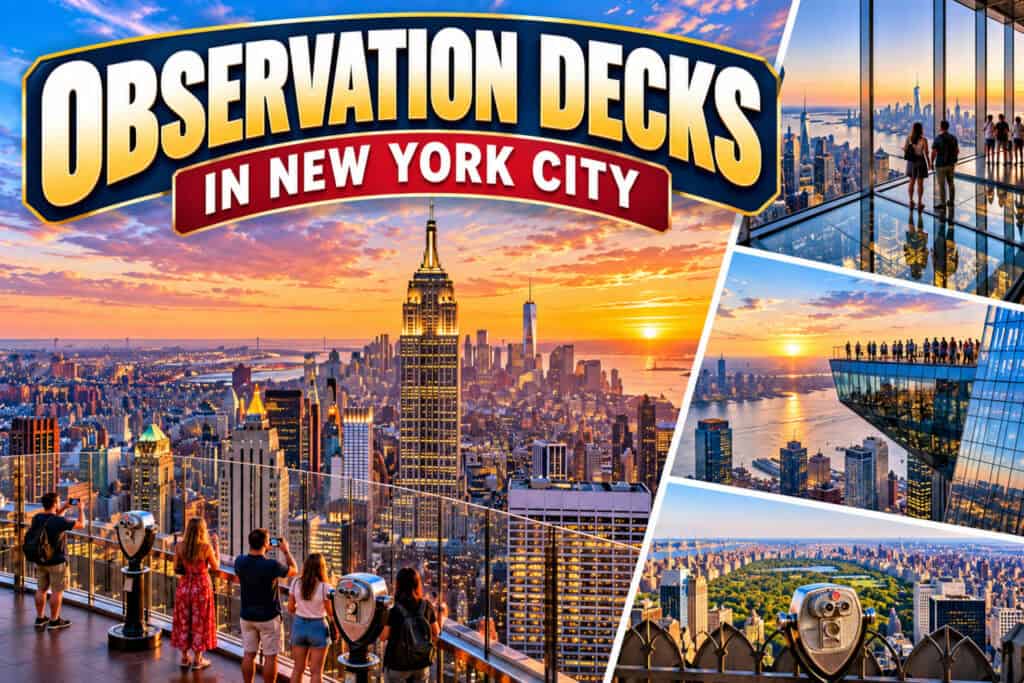
Edge: an outdoor platform that projects into the sky
At Hudson Yards, Edge's triangular outdoor terrace juts beyond the side of 30 Hudson Yards.
Its glass floor reveals the drop below, and the outward-angled glass barriers amplify the sensation of standing over the city.
This is the obvious choice for someone who enjoys the physical feeling of height rather than simply seeking a familiar skyline image.
Edge is no longer just a trip up to an outdoor platform.
Seven indoor immersive installations, introduced in 2026, are part of the regular visit, followed by views from the enclosed 100th-floor space and the outdoor terrace.
That matters if you are comparing ticket value: you are purchasing a longer, staged experience rather than admission to one viewing platform.
It does not make the outdoor area immune to wind or severe weather, however.
Allow about 60-90 minutes, the operator's typical estimate for the full experience, and more if you linger for the outdoor views or encounter peak-time demand.
Pair Edge with Hudson Yards or a walk on the nearby High Line.
If your group dislikes transparent floors, look-down angles, or strong wind, the dramatic elements may be liabilities rather than selling points.
Empire State Building: visit the icon rather than frame it from elsewhere
The Empire State Building is a different decision from Top of the Rock.
You are inside the landmark: you move through historical and interpretive exhibits before reaching the open-air 86th-floor observatory, surrounded by the building's familiar Art Deco architecture.
The tower opened on May 1, 1931, and the visit connects those early skyscraper years to the working New York skyline outside.
The standard observation experience includes the 86th-floor deck and exhibits.
The enclosed 102nd-floor observatory is an additional ticket choice, not an automatic part of every booking.
The higher level changes the perspective and the amount of time you spend inside, but it does not change the basic photo problem: you cannot capture a full exterior photograph of the Empire State Building from its own observation decks.
Budget at least about an hour for the exhibits and 86th floor, or roughly 1.5-2 hours if you add the 102nd-floor experience, before allowing for exceptional queues.
The building fits naturally with a Midtown day around 34th Street.
Choose it for the architecture, history, and pleasure of being in a famous building; choose Top of the Rock instead if the building itself is the main subject of your skyline photograph.
One World Observatory: Downtown, the rivers, and the harbor
One World Observatory occupies the 100th through 102nd floors of One World Trade Center.
The SkyPod elevator and the on-site presentation are part of the arrival, but the most important distinction is geographical: from Downtown, the frame opens toward New York Harbor, the rivers, the Statue of Liberty, and Brooklyn Bridge when visibility permits.
That is a different picture from Midtown's tightly packed skyscrapers.
The viewing areas are indoors.
This makes One World a practical option for visitors who prefer to stay out of the wind or cold, but an enclosed observatory is not a solution to fog, cloud, or rain-obscured views.
Window reflections may also matter if photography is your main reason for going.
Do not book it expecting the Empire State Building to dominate the scene the way it can from Rockefeller Center.
Allow approximately 45-60 minutes for the observatory itself, with extra time for security, access, and the rest of your Downtown activities.
The Oculus and the 9/11 Memorial area are nearby, though the memorial deserves its own unhurried and respectful visit.
A Midtown observatory and One World can make a worthwhile two-deck combination when they fall on different neighborhood days rather than being rushed into one cross-city outing.
Two different ways to look down on New York
Centre 360: a free cupola above City Hall's neighborhood
Centre 360 opened to the public in June 2026 following the restoration of the cupola on the David N. Dinkins Municipal Building at 1 Centre Street.
Visitors reach a small, open viewing space beneath the gilded Civic Fame statue and look around Lower Manhattan from a civic landmark that was not previously available as a standard tourist observatory.
Its historic setting is the attraction as much as the panorama.
There is no admission charge, but free does not mean drop-in. The city runs limited weekday sessions with an escorted ascent.
Its booking process requires a confirmation step: the initial reservation email is not the final admission confirmation; a later message contains visit information and a QR code.
Updated city guidance allows occasional walk-ins when cancellations or no-shows create space, but these places are not guaranteed.
The published rules also require children to be at least 42 inches tall, and the route includes confined passages, a step, and potentially extended standing.
Contact the operator about any needed accessibility accommodations rather than assuming the route fits every visitor.
Allow about one hour for the full escorted visit, even though time actually looking out from the cupola is roughly 15-20 minutes.
City Hall Park and the Civic Center make sense before or after a confirmed session.
Skip it if your schedule cannot depend on a hard-to-secure reservation, if your party does not meet the height rule, or if the route's physical constraints are unsuitable.
Times Square Skywalk: the crossroads from 19 floors up
Times Square Skywalk at One Times Square opened in April 2026, giving visitors an open-air wraparound viewpoint and a section of glass walkway 19 floors above Times Square.
Here the memorable photograph looks down at the crowds, electronic signs, and street grid.
You may also see across Manhattan, but this is a close-up of an exceptionally busy urban intersection rather than the distant, high-elevation composition of Edge or One World Observatory.
The building's association with the New Year's Eve Ball is part of its appeal, but ticket products differ.
The current standard Skywalk listing includes a glass elevator ride, the Eternal Midnight countdown experience, a virtual 1930s airship flight, and a time-traveling taxi.
Up-close access to the New Year's Eve Ball is not included in that basic ticket; it is offered separately, including through the fuller Ball experience.
Check the exact inclusions and any add-on charges at checkout.
Allow about 45-75 minutes as an editorial estimate for the Skywalk and whatever elements your ticket includes, plus possible entry waits.
It pairs with a Times Square or Theater District visit, not a special cross-city trip just to see the wider Manhattan skyline.
If you already dislike the bustle around Times Square, the elevation probably will not change your mind about the neighborhood.
How the observation decks actually compare
A taller deck does not necessarily produce a better picture.
Where you stand determines which buildings appear in front of you, and the experience included in admission determines whether you spend your time admiring the view or moving between installations.
| Venue | Viewing format and strongest frame | What basic admission is primarily for | The trade-off |
|---|---|---|---|
| Top of the Rock | Multi-level decks, open-air top; Empire State Building and Central Park | Classic outdoor skyline viewing | Premium photo experiences such as Beam and SKYLIFT cost extra; upper levels are exposed. |
| SUMMIT One Vanderbilt | Mirrored indoor installations, glass ledge, open-air terrace; Midtown | Art-led, multi-room experience with skyline views | Bright reflections, sensory effects, a sequential route; Ascent is extra. |
| Edge | Indoor views plus projecting open-air terrace and glass floor; Hudson Yards | Seven indoor installations and outdoor deck | Height exposure and weather sensitivity can be part of the experience. |
| Empire State Building | Open-air 86th-floor deck; skyline from inside the landmark | Historical exhibits and the 86th-floor observatory | The tower itself is missing from your panorama; 102nd-floor access is an upgrade. |
| One World Observatory | Enclosed panorama; harbor, rivers, bridges, Lower Manhattan | Indoor observation and arrival presentation | Glare and low cloud can obstruct views; no outdoor deck. |
| Centre 360 | Small open-air historic cupola; Civic Center and Lower Manhattan | Free, reservation-based civic viewing visit | Very limited sessions, weekday-only access, height and route constraints. |
| Times Square Skywalk | Open-air wraparound deck and glass walkway; Times Square below | Elevated street view, glass elevator, and themed interactive exhibits | Lower perspective than major skyscraper decks; Ball close-up costs extra. |
For the average visitor choosing only one paid ticket, start with your desired image: Top of the Rock for the Empire State Building in frame, One World for the harbor, Empire State for landmark history, SUMMIT for immersive photographs, or Edge for the sensation of being outdoors over the city.
There is no one deck that delivers all five experiences equally well.
Choose a deck that fits the part of the city you are visiting
A quick look at the map can be misleading: these attractions sit in different parts of Manhattan.
Two spots that appear close in a list may require a separate subway ride and security queue.
| Area or day already on your schedule | Deck that fits | Sensible nearby pairing | When the detour stops making sense |
|---|---|---|---|
| Rockefeller Center / Fifth Avenue / Midtown north | Top of the Rock | Rockefeller Center plaza, St. Patrick's Cathedral, Fifth Avenue | You already booked another Midtown deck for the same Empire State Building photograph. |
| Grand Central / East Midtown | SUMMIT One Vanderbilt | Grand Central Terminal and the surrounding blocks | You have less than two flexible hours between timed commitments. |
| 34th Street / central Midtown | Empire State Building | Herald Square and nearby Art Deco architecture | Your only goal is a photograph featuring the full Empire State Building itself. |
| Hudson Yards / west side | Edge | Hudson Yards and the High Line | You are Downtown and would be crossing the city solely to add a similar skyline ticket. |
| World Trade Center / Financial District | One World Observatory | Oculus and the 9/11 Memorial area | Your desired subject is the close-up Midtown skyline rather than the harbor. |
| Civic Center / City Hall | Centre 360 | City Hall Park and nearby Lower Manhattan streets | You have no confirmed session or cannot meet the access requirements. |
| Times Square / Theater District | Times Square Skywalk | Times Square and a Broadway-area visit | You want the distant whole-city panorama more than the spectacle below. |
Avoid treating Hudson Yards and the World Trade Center as one casual neighborhood walk.
They work on separate days, or as a deliberately planned subway trip.
Likewise, Top of the Rock and SUMMIT can both frame the Empire State Building: buying both just for the same photographic subject is often redundant, even though the on-site experiences differ sharply.
Practical choices before buying tickets
The time estimates above describe time spent at or inside the attractions.
They are not guaranteed entry-to-exit durations, queue forecasts, or travel times from your hotel.
| What could change your decision | Practical check or adjustment |
|---|---|
| Sunset slots and crowds | Golden hour is popular. Decide whether that light is worth possible higher demand and longer access waits. Book the intended time instead of assuming you can arrive whenever you wish. |
| Clouds, fog, rain, and visibility | Check the forecast and the actual skyline before a nonrefundable booking. Indoor One World protects you from weather, not from poor visibility; exposed spaces can have separate weather restrictions. |
| Total visit time | Add security, elevators, waiting, upgrades, and the trip to the venue on top of the stated onsite allowance. SUMMIT's sequential rooms and Centre 360's escorted procedure cannot always be hurried. |
| Cold, wind, or fear of heights | Top of the Rock, Edge, the SUMMIT terrace, Centre 360, and Skywalk have exposed sections. One World is fully enclosed; Edge also has an indoor viewing area. Transparent ledges are a specific challenge for some visitors. |
| Reflections and sensitive eyes | SUMMIT has deliberately reflective floors and walls. Take the operator's sunglasses, clothing, and footwear guidance seriously; conventional skyline photographs may be simpler elsewhere. |
| Children and supervision | Centre 360 requires children to be at least 42 inches tall and accompanied by an adult. Other decks vary in what young children find enjoyable; compare calm viewing with interactive, bright, or height-focused effects. |
| Wheelchairs, strollers, and mobility limitations | Do not assume every route has identical access. Major operators publish accommodation and stroller policies; Centre 360 specifically notes a step, confined space, and prolonged standing. Verify your particular needs directly before booking. |
| Large bags and luggage | Check the operator's prohibited-item and storage rules. Centre 360 has no storage facilities and permits only a limited-size personal item; do not arrive straight from the airport with suitcases. |
| A free reservation or timed ticket | For Centre 360, wait for the actual confirmed reservation and QR code, and bring required identification. Walk-in spaces are a possibility, not a plan. Elsewhere, note the entry window and grace-period policies. |
| What is and is not included | The Beam, SKYLIFT, SUMMIT Ascent, the Empire State Building's 102nd floor, and enhanced Ball access at One Times Square are distinct extras or ticket tiers. Compare the final checkout inclusion, not the headline attraction name. |
| Transport and parking | You do not need a car for this group of Manhattan attractions. Use subway or walking connections that suit the rest of the day; parking and cross-town driving add friction rather than helping. |
| Refunds or date changes | Policies vary by venue and ticket class. Check weather closures, rescheduling options, and cancellation terms before you pay; a timed reservation does not by itself guarantee a clear view. |
If you want a skyline without a paid tower ticket
A view of the Manhattan skyline can be more satisfying than a view from inside it.
Brooklyn Bridge Park and the Brooklyn Heights waterfront let you see Downtown's buildings across the East River, while the Staten Island Ferry provides a moving harbor perspective.
Those are useful lower-cost alternatives if your real goal is a wide skyline photograph, but they are not free versions of the 70th- or 100th-floor experience.
Centre 360 is the genuine free elevated option covered here, provided you can secure access.
Sources
Official operator and New York City resources checked October 19, 2026.
Ticket prices, packages, admission slots, weather rules, and access arrangements can change; confirm them with the operator before visiting.
- Rockefeller Center - Top of the Rock visiting guide
- SUMMIT One Vanderbilt - official visit information
- Edge NYC - visitor FAQs and ticket inclusions
- Empire State Building - visitor FAQs
- Empire State Building - building history
- One World Observatory - plan your visit
- Centre 360 - official city FAQs
- NYC DCAS - August 2026 Centre 360 access update
- One Times Square - Skywalk opening announcement
- One Times Square - ticket types and inclusions