
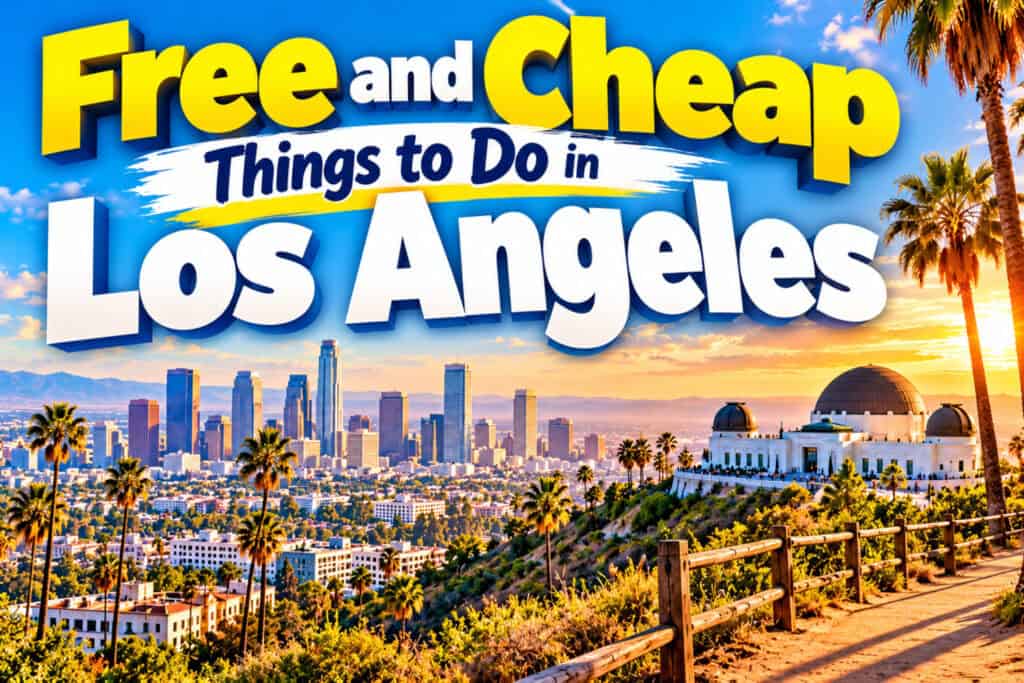
Griffith Observatory gives you city views and science exhibits, the Getty Center pairs paintings with a sculpted garden, The Broad brings contemporary art downtown, and Venice Beach puts the ocean beside an unruly public boardwalk.
These are among the strongest free things to do in Los Angeles because the experience itself has no general-admission charge.
Some places still require a free ticket, and parking or special experiences can cost extra.
The smarter budget outing stays in one part of LA and accounts for the actual entry rules.
A no-admission museum across town may be a worse bargain than several free stops close together.
Choose an area first, then check its tickets and transportation before setting out.
This selection focuses on the City of Los Angeles. Nearby Santa Monica is a separate city and appears only where the boundary changes a choice.
Quick picks for different kinds of free days
For a first visit, choose the experience you want most.
The places below vary more in travel effort and access conditions than in general-admission price.
| If you want | First choice | What makes it worthwhile | Main barrier besides admission |
|---|---|---|---|
| Skyline views and hands-on astronomy | Griffith Observatory | Terraces, a Foucault pendulum and public telescopes | Hilltop access, crowds and paid parking |
| Art, architecture and gardens | Getty Center | Travertine buildings, galleries and the Central Garden | Required free timed-entry reservation and paid parking |
| Contemporary art downtown | The Broad | A major collection behind a striking patterned facade | Free timed ticket recommended; standby line may mean a wait |
| Beach energy and a quieter walk | Venice Boardwalk and Canals | Oceanfront activity followed by residential canal bridges | Cross-city travel, parking and narrow paths |
| Early Los Angeles history | El Pueblo and Avila Adobe | Public plaza and a surviving 1818 adobe home | Historic interiors and tours have limited schedules |
| Indoor science with children | California Science Center | Hands-on science and a kelp-forest exhibit | Some galleries may change; IMAX and special shows cost extra |
Free hilltop views and Westside art
The two big Westside-and-hillside choices reward different interests.
Griffith is the pick for city views and astronomy; Getty needs more of your day but adds architecture, gardens and galleries.
Griffith Observatory: the city below and science inside
The Observatory's terraces look toward the Hollywood Sign and across Los Angeles, while inside are free exhibits.
On clear evenings, public telescope viewing may be offered, subject to conditions and staffing.
Its Foucault pendulum, a 240-pound weight swinging on a 40-foot cable, demonstrates the Earth's rotation.
Inside Wilder Hall, a Tesla coil demonstration adds a different kind of physical science, though its sharp sounds are not for everyone.
The Samuel Oschin Planetarium requires a ticket despite free Observatory admission, as of October 2026.
The DASH Observatory/Los Feliz bus is a public-transit option for the hilltop, but check LADOT's route and fare rather than assuming the ride costs nothing.
On-site parking is charged, and access to the hilltop takes planning.
Set aside 1.5 to 2.5 hours on site, excluding travel and waiting. Science-minded families gain more here than at a sidewalk landmark.
If slopes, crowds or loud demonstrations are a problem, concentrate on the terraces and quieter indoor spaces, or choose an easier museum visit instead.
Pairing it with Hollywood means arranging a separate connection.
Getty Center: a free museum that needs a reservation
The tram climb leads to Richard Meier's travertine-clad buildings, galleries and terraces above the Westside.
Robert Irwin's Central Garden is itself a designed artwork, with intricate planting and carefully arranged views.
The Center opened in 1997, so the grounds are modern architecture rather than an old estate, a useful distinction when choosing between museums.
A free timed-entry reservation is required as of October 2026, and the Getty charges a parking fee.
Some galleries are already closed for modernization, and the Getty Center is scheduled to close completely to the public from March 15, 2027, until spring 2028.
Nearby street parking is not a reliable alternative.
Reserve entry before committing to the trip and check which galleries are open. The gardens reward time beyond the galleries.
Plan on 2.5 to 4 hours to see the art and garden properly. The trip suits architecture lovers, not a rushed cross-city photo detour.
The Hammer in Westwood can follow on a deliberate Westside day; the two museums are not next-door stops.
Hammer Museum: art without the Getty arrival ritual
In Westwood, the Hammer's gallery rooms and courtyard provide a smaller-scale contemporary art visit.
Opened in 1990 and associated with UCLA, it has changing exhibitions.
General admission is free, and individual advance booking is not usually needed.
For a less structured art stop, budget 1 to 1.5 hours.
Parking costs extra, and the museum is generally closed Mondays. It fits a Westwood outing, not a walk from Getty.
Downtown: free contemporary art, an adobe house and civic spaces
Downtown has several free cultural stops in one district. Gallery hours, library tours and historic-building access still have to line up.
The Broad: free collection, with a standby option
The Broad's third-floor galleries hold contemporary work, a substantial art visit without an admission fee.
Yayoi Kusama's Infinity Mirrored Room is also free, but it requires a separate timed reservation, so a general gallery ticket does not include access.
The main collection has free general admission as of October 2026.
Advance timed tickets are recommended, while a standby line allows walk-up visitors to seek entry when capacity permits.
Standby suits flexible Downtown visits, not a tight schedule. Allow 1 to 2 hours inside, plus any line.
The natural pairing is MOCA Grand Avenue. Grand Avenue itself adds a short walk.
MOCA Grand Avenue: the nearby second art museum
Arata Isozaki's 1986 building houses contemporary art almost across Grand Avenue from The Broad.
The second gallery requires no cross-city transfer.
General admission to MOCA Grand Avenue is free, but a ticket is required under the museum's October 2026 policy.
Advance booking is recommended; same-day capacity can vary.
Allow about 45 to 90 minutes, or skip the second gallery if you've had enough indoor art.
Check the Grand Avenue campus, not the separately scheduled Geffen Contemporary.
El Pueblo and Olvera Street: the older city in physical form
Walk through the historic plaza and into Avila Adobe, an 1818 house arranged to suggest a later, mid-19th-century domestic interior.
The adobe gives the district a tangible historical center.
The historic district's story also includes Indigenous Yaanga, which predates the Spanish colonial settlement of 1781.
Public plaza access and admission to the city's listed historic museums are free, although indoor hours differ from outdoor access.
As of October 2026, free guided tours run on scheduled days and must be requested at least two weeks ahead.
Tours with minors also have waiver requirements.
Allow about 1 to 1.5 hours for a self-guided visit to the historic core, with Union Station nearby.
It suits history-focused families more than art-only visitors.
Central Library: look up before you look at the shelves
The 1926 Goodhue building has exterior sphinxes and a pyramid, while the 1993 Tom Bradley Wing adds an eight-story atrium.
Its chandeliers and public art make the interior worth examining.
The public spaces are free during library access hours.
Docent-led architecture tours follow a limited schedule, so arriving at any random hour does not guarantee one.
Allow about 30 to 60 minutes for a self-directed look, or about an hour for a tour.
It suits a Downtown architecture walk or a hot afternoon, but skip it if you expect a major exhibition.
Gloria Molina Grand Park: space between cultural stops
The 12-acre civic park spreads across terraces and lawns toward City Hall, with the restored Arthur J. Will Memorial Fountain as a visual center.
Opened in 2012, it makes a useful outdoor pause.
A 20 to 45-minute visit covers a walk or rest. Fountain operations and park access can vary.
It is not a good reason to travel across Los Angeles by itself. Combine it with the Grand Avenue museums when their schedules work.
Venice: lively shoreline or quiet canals
Venice has two remarkably different free walks in the same neighborhood.
You can see public beach life and street activity without buying an attraction ticket, then leave much of the noise behind near the canals.
Venice Boardwalk and Canals: two free walks, one neighborhood
Ocean Front Walk, usually called the Venice Boardwalk, stretches for more than 2 miles beside the beach, passing skate activity and public gathering spaces.
The historic Venice Canals replace that noisy setting with narrow residential paths and footbridges over six waterways.
The canals trace their identity to Abbot Kinney's Venice development in 1905, a more specific reason to go than another waterfront photograph.
The two walks take roughly 1.5 to 3 hours, depending on beach time.
The Boardwalk is a stronger choice for people-watching and public activity.
The canals fit a quieter architectural stroll, provided you stay on public paths and respect the homes alongside them.
Canal walkways are narrower than the beach promenade and should not be assumed equally convenient for every stroller or wheelchair user.
Both walks are free; parking and rentals cost extra. Santa Monica Pier is a separate coastal option outside the City of Los Angeles.
Its amusement rides are not part of the free Venice experience.
Hollywood and Museum Row: the short stops
These places make more sense as additions to nearby outings than as reasons to cross the whole city.
One is a classic Hollywood photo stop; the other two are outdoor art and Ice Age science in Mid-City.
Hollywood Walk of Fame: stars on a working sidewalk
The Walk of Fame's stars occupy public sidewalks along Hollywood Boulevard and Vine Street, with the first stars installed in 1960.
The stars require no ticket. Street performers and paid photo pitches are optional.
Finding particular names takes roughly 20 to 45 minutes. Skip a half-day here unless Hollywood is your destination.
Griffith is a stronger longer outing, with a separate hilltop trip.
La Brea Tar Pits: public grounds during renovation
At Hancock Park, dark asphalt seeps emerge within an ordinary-looking urban landscape.
They have preserved Ice Age plants and animals dating back as far as 50,000 years, an extraordinary contrast to nearby museum buildings and city streets.
The Lake Pit and selected outdoor excavation areas give a sense of the actual process rather than just displaying replicas.
The La Brea Tar Pits museum building remains closed for renovation as of October 2026.
Selected outdoor grounds remain accessible, subject to work zones.
Budget 30 to 60 minutes outdoors; skip if you want the closed indoor Fossil Lab or unrestricted pit access.
The sensible next stop is Urban Light nearby.
Urban Light: 202 streetlamps instead of gallery admission
Chris Burden's Urban Light assembles 202 restored cast-iron streetlamps into a dense outdoor installation at LACMA.
Its repeated rows create a striking walk-through art experience, particularly for visitors who enjoy photography.
Installed in 2008, it is separate from the museum's ticketed galleries.
Plan on 15 to 30 minutes and pair the installation with the Tar Pits grounds rather than treating it as a museum afternoon.
Exterior access may be affected by work or temporary restrictions.
Indoor LACMA galleries follow their own ticket rules, especially for nonresidents.
Exposition Park: indoor science without a full museum ticket
The California Science Center is the main family-focused indoor alternative on this list.
It also requires the clearest check of what is actually open.
California Science Center: free galleries, separate paid experiences
Hands-on science galleries and a kelp forest exhibit with a 188,000-gallon tank make the Science Center a substantial Exposition Park visit.
The tank puts an underwater ecosystem in front of young visitors.
General access to the center's core exhibitions is free, while IMAX and some special experiences have their own tickets.
Space Shuttle Endeavour is not on public display as of October 20, 2026.
The announced opening for its new air and space facility is November 13, 2026.
Verify the actual opening and exhibit access before a space-shuttle trip.
Budget 1.5 to 2.5 hours for accessible science exhibits, excluding ticketed programs.
Choose this for indoor family learning; skip it as an Endeavour-specific stop until display access is confirmed.
Compare the choices that look similar on a free-attractions list
Two free places can demand very different effort. Experience, location and the conditions for entry make the difference.
| Choose between | First option wins when | Second option wins when | Deciding trade-off |
|---|---|---|---|
| Griffith Observatory or Getty Center | You want Hollywood Sign views, astronomy and a possible evening visit | You want art, garden design and architecture | Planetarium costs extra; Getty needs a free reservation and is scheduled to close from March 15, 2027 |
| The Broad or MOCA Grand Avenue | You want the Broad's collection and separately reserved free Kusama room | You want another contemporary museum in the same Downtown area | Broad has general-admission standby; MOCA requires a ticket despite free entry |
| The Broad or Hammer Museum | Downtown is your base and you want neighboring cultural stops | Westwood is more convenient and you want art without individual advance booking | Hammer parking is paid; the museums are in different districts |
| Venice Boardwalk or Venice Canals | Beach crowds, skaters and street life appeal | Quiet bridges and residential water views appeal | The canal paths are narrower and less suitable for some mobility needs |
| La Brea public grounds or Urban Light | You want real asphalt seeps and Ice Age excavation | You want an outdoor artwork made from 202 streetlamps | Tar Pits museum is closed; both are short outdoor stops |
| Hollywood Walk of Fame or Griffith Observatory | You have little time and want a sidewalk-star photograph | You want views and science worth a longer outing | Getting to the Observatory hilltop takes more effort |
Neighborhood combinations for low-cost days
A Downtown museum visit can extend into another gallery or park on foot, while the Getty requires a separate trip.
Keeping stops together matters as much as their admission price.
| Area or visitor situation | Combine sensibly | Good for | Avoid assuming |
|---|---|---|---|
| Downtown Grand Avenue | The Broad, MOCA Grand Avenue and Grand Park | Art and a short civic walk | The Getty is a nearby add-on |
| Downtown history and architecture | El Pueblo, Union Station area and Central Library with a walk or transit | History, architecture and car-free travel | Free guided tours are available at any hour |
| Hollywood and Griffith | Walk of Fame with a separate bus or transit leg to Griffith Observatory | Landmark photos followed by a hillside view | The Observatory is an easy level walk from Hollywood Boulevard |
| Westside art | Getty Center or Hammer Museum, with a planned connection if doing both | Art-focused half-day or longer | The two museums are adjacent or both have free parking |
| Venice coast | Boardwalk and Canals | Beach activity paired with residential waterways | Santa Monica Pier falls inside Los Angeles city limits |
| Mid-City and Museum Row | La Brea outdoor grounds and Urban Light | Short outdoor science and art stops | The Tar Pits indoor museum is available |
| Exposition Park | California Science Center, focusing on confirmed open galleries | A family science outing | Endeavour is already viewable in October 2026 |
How to keep a free outing from turning expensive
A parking fee or paid add-on can change the cost of an otherwise free day.
The best transport option depends on the area and the venue's entry policy.
| Planning barrier | Where it matters | What to do | What could go wrong |
|---|---|---|---|
| Timed entry and scheduled closure | Getty Center; separately, Getty Villa | Reserve free entry and check gallery closures; Getty Center closes March 15, 2027, with reopening planned for spring 2028 | A free ticket does not override a closure; the Villa remains a separate destination |
| Standby line or optional free ticket | The Broad | Reserve a timed ticket if possible, or accept a capacity-dependent walk-up wait | A spontaneous arrival may take longer than expected |
| Free admission with required ticket | MOCA Grand Avenue | Obtain the free ticket; advance booking is recommended | You cannot count on immediate gallery access |
| Parking fee | Getty Center, Griffith Observatory and Hammer Museum | Compare official garages, transit and drop-off before setting a budget | Car access can cost more than the admission-free activity |
| Paid add-on | Griffith planetarium and California Science Center IMAX | Decide whether these ticketed experiences justify the extra charge | Free general admission does not include these paid programs |
| Separate free reservation | The Broad's Kusama Infinity Mirrored Room | Book the dedicated free timed ticket, distinct from general admission | Regular museum standby does not secure access to the installation |
| Resident-only admission | LACMA indoor galleries | LA County residents should confirm weekday after-3-p.m. eligibility and ID | Out-of-county visitors may owe general admission |
| Museum pass or Discover & Go | Los Angeles Public Library cultural passes | Qualifying local adults should confirm LAPL card, residency and reservation rules | A visitor without an eligible card cannot rely on the pass |
| Public grounds rather than indoor access | La Brea Tar Pits | Confirm open parts of Hancock Park before going | Renovation may block the museum and selected outdoor areas |
| Transit fare cap | Metro travel between areas | Check valid payment and fare-capping rules on Metro's website | Separate fares and transfers can change the real day cost |
| DASH Observatory/Los Feliz route | Griffith Observatory | Check LADOT schedule, operating status and fare | The last climb or connection may be less convenient than expected |
| Advance tour booking | El Pueblo and Central Library | Request an El Pueblo tour at least two weeks ahead; check Central Library's scheduled docent tours | The two free-tour programs have different booking rules |
| Gallery opening and renovations | California Science Center and other museums | Confirm which exhibitions are actually open | A headline exhibit may be closed or not yet launched |
Metro's standard base fare was $1.75 as of October 2026, with a $5 daily and $18 seven-day cap under qualifying fare-capping rules.
These charges depend on the qualifying fare-payment method and may change.
Check Metro before deciding that several distant stops cost no more than one local outing.
Free for locals, but not for every visitor
LACMA's general galleries have a Los Angeles County resident benefit on weekdays after 3 p.m. with ID, subject to the museum's October 2026 ticket rules.
That is distinct from the generally accessible Urban Light exterior.
The Los Angeles Public Library's Discover & Go museum pass program also depends on qualifying library-card status, local residency, age and available reservations.
These conditional programs do not give every visitor free museum admission.
Two small paid upgrades worth distinguishing
At Griffith Observatory, the planetarium program is a paid option layered onto a free science visit.
The listed adult planetarium price was $12 as of October 2026. You can leave it out and still visit the terraces and exhibits.
Watts Towers is a different choice entirely: a large-scale assemblage of decorated towers and mosaics in South Los Angeles.
Access beyond the free exterior view is through an operator-guided tour; the adult tour price was $12 as of October 2026, with different rates for some visitors.
Watts takes a separate trip from Downtown or Hollywood.
Check Watts Towers' tour status before deciding the cost is worthwhile. Both are optional, not part of free admission.
Build your day around one area
The sensible first decision is which area of Los Angeles matches your interests, because a group of reachable places beats a chain of zero-dollar attractions on opposite sides of the city.
Before setting out, the venue's booking rules and the cost of parking versus transit determine whether a second stop belongs in the day.
Sources
- Griffith Observatory visitor and transportation information: Access to the hilltop, parking guidance and connections to public transportation.
- Getty Center modernization and temporary closure: Gallery closures and the planned March 2027 to spring 2028 shutdown.
- Getty Center visitor questions: Free timed reservations, parking conditions and arrival rules.
- The Broad general admission: Free collection, standby arrangements and the separate Infinity Mirrored Room reservation.
- El Pueblo guided tours: Booking details for historic-district tours and current availability.
- MOCA visitor questions: How free general admission and tickets work at the Grand Avenue museum.
- California Science Center opening announcement: City announcement of the Endeavour opening planned for November 13, 2026.
- La Brea Tar Pits and Hancock Park: Outdoor features and areas to check during renovation.
- LACMA admission tickets: Rules for general admission and Los Angeles County resident benefits.
- Metro fare capping: Fare-cap rules and payment details for a cross-city trip.