
North Carolina is easier to plan when you stop treating it as one giant attraction list.
The mountains in the west, the Piedmont cities in the center, and the coast in the east can produce completely different trips - and trying to squeeze all three into a short visit usually means seeing more highway than North Carolina.
For a first trip, start with the region that best matches what you actually want to do. Choose the mountains for Blue Ridge scenery, waterfalls, hiking and mountain towns.
Choose the Piedmont for museums, food, sports and city activities. Choose the coast for beaches, maritime history, wildlife and a slower pace. Then narrow the list by time, driving tolerance, season, physical effort, crowds and value.
Quick picks
| If you want... | Start with... | Why it works | Watch for... |
|---|---|---|---|
| Mountain scenery | Asheville and the Blue Ridge | Scenic drives, mountain views, waterfalls and a strong food-and-town base | Long drives between stops and peak-season crowds |
| Beaches and coastal history | Outer Banks | Barrier-island scenery, beaches, Wright Brothers history and lighthouse country | Long distances, weather and seasonal access |
| Waterfalls | Brevard and Pisgah area | One of the easiest places to build a waterfall-focused trip | Trail effort, parking and seasonal conditions |
| A classic first-time mountain trip | Asheville + Blue Ridge Parkway | Easy to combine an interesting city with scenic day trips | Do not overpack the Parkway into one day |
| Museums and an urban weekend | Raleigh and the Triangle | Strong indoor options, gardens, food and cultural stops | Attractions are spread across the metro area |
| Sports and city entertainment | Charlotte | Professional sports, events, food and major urban attractions | It is a better fit for event-driven trips than for iconic NC scenery |
| A historic city plus beaches | Wilmington | Walkable historic atmosphere with beach access nearby | Decide whether the city or the beach is your main priority |
| Easy scenic payoff | Scenic drives and overlooks | Big views without committing to a long hike | Road status, fog, daylight and traffic |
| A family trip | Coast, Triangle, zoo and aquarium options | Good mix of outdoors, animals, museums and beach time | Age, walking tolerance and weather backup matter |
| A quiet getaway | Smaller mountain or coastal towns | Slower pace and more local atmosphere | Fewer restaurants, shops and backup activities |
| A short weekend | One region only | More time doing things and less time changing bases | FOMO about the other side of the state |
Mountains, Piedmont or Coast?
North Carolina's biggest planning decision is geographic.
The three broad regions are not interchangeable, and each rewards a different kind of trip.
| Region | Best for | Strongest experiences | Main trade-off | Less suitable if... |
|---|---|---|---|---|
| Mountains / Western North Carolina | Scenery, hiking, waterfalls, road trips, mountain towns | Blue Ridge Parkway, Great Smoky Mountains, Pisgah, Asheville, Boone, Brevard | Big scenic payoff, but more driving and terrain | Your main goal is beach time or a low-driving urban weekend |
| Piedmont | Museums, food, sports, gardens, family attractions, city breaks | Raleigh, Durham, Charlotte, Winston-Salem, zoo and cultural sites | Convenient variety, but less dramatic landscape | You want the trip to revolve around mountains or beaches |
| Coast | Beaches, barrier islands, maritime history, wildlife, relaxed trips | Outer Banks, Wilmington, Cape Hatteras, Beaufort and coastal parks | Distinctive coastal character, but long distances and weather exposure | You are based far west with very limited time |
If you have only a weekend, pick one region.
With three or four days, you can go deeper in one region and perhaps add a nearby second base.
A longer road trip can combine regions, but it works best when the driving is part of the experience rather than an inconvenience between checklist stops.
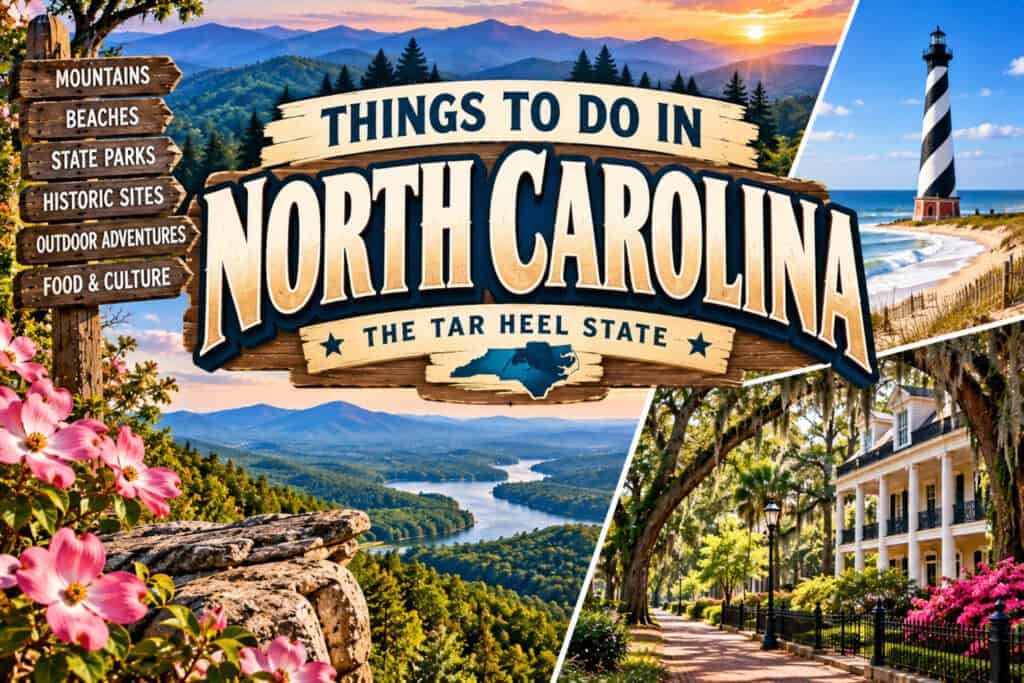
How much North Carolina can you realistically see?
| Trip length | Realistic approach | Good planning rule |
|---|---|---|
| 1 day | One city, park or compact area | Do not build a statewide itinerary |
| Weekend | One main region and one base | Pick 3-5 priority experiences |
| 3-4 days | One region in depth, or two nearby clusters | Keep transfer days short |
| 5-7 days | Multi-region travel becomes realistic | Build around two or three bases, not a long daily commute |
| Longer road trip | Mountains, Piedmont and coast can all fit | Treat the route itself as part of the trip |
The useful question is not "How many attractions can I fit?"
It is "How many sightseeing hours are left after driving, parking, meals, weather delays and the time each experience actually needs?"
Best things to do in the North Carolina mountains
Drive the Blue Ridge Parkway
The Blue Ridge Parkway is one of the state's strongest low-effort scenic experiences.
It works especially well for travelers who want mountain views without building the trip around difficult hikes.
The mistake is treating it like a normal highway.
The value comes from overlooks, short walks, side trips and unplanned stops, so a route that looks short on a map can easily become a full day.
Best for: first-time mountain visitors, couples, photographers, fall trips and travelers who prefer scenery to strenuous activity.
Less suitable if: you dislike long scenic drives, need a tightly timed itinerary or are visiting when poor visibility or road closures limit the experience.
Explore Asheville
Asheville is the easiest all-round mountain base for travelers who want both a city experience and access to Western North Carolina scenery.
It combines restaurants, breweries, arts and architecture with day-trip access to the Blue Ridge, waterfalls and forest recreation.
Choose Asheville if you want mountain scenery without giving up food and city amenities.
Choose a smaller mountain town instead if quiet atmosphere, trail access or a slower pace matters more than nightlife and restaurant choice.
Decide whether Biltmore is worth your day
Biltmore Estate is one of the state's best-known paid attractions, but it should not be an automatic must-do.
It makes the most sense for travelers genuinely interested in historic houses, architecture, gardens and the estate experience.
The official visitor information recommends allowing at least a full day, so the real cost is not only the ticket - it is also the time you are choosing not to spend elsewhere.
Worth it if: the estate itself is a major interest and you are comfortable giving it a substantial part of the day.
Skip or deprioritize it if: your trip is short and you would rather use that time for mountain scenery, hiking, waterfalls or exploring Asheville.
Hike in Great Smoky Mountains National Park
Great Smoky Mountains National Park is a strong choice for travelers who want a national-park experience with forests, mountain scenery and a wide range of trails.
Do not choose a hike only from a photo or a "best trails" list.
Match distance, elevation, surface and expected time to the weakest hiker in your group.
Current trail and road conditions can change, so check official park conditions before building a day around a specific route.
Chase waterfalls around Brevard and Pisgah
Waterfalls are one of Western North Carolina's strongest signature experiences.
Brevard and the Pisgah area make a practical base because you can combine multiple falls with forest scenery and short hikes without driving across the entire mountain region.
The useful comparison is not simply which waterfall is "best."
Compare trail effort, parking, detour time, crowd level and scenic payoff.
A smaller waterfall close to your route can be a better choice than a famous one that consumes half the day.
Try Boone and Blowing Rock for a different mountain base
Boone and Blowing Rock are good alternatives when you want High Country scenery, mountain-town atmosphere and access to nearby outdoor attractions without centering the trip on Asheville.
They are especially useful for Blue Ridge-focused trips and travelers who enjoy small-town browsing as much as the surrounding landscape.
Best things to do in the Piedmont
Spend a day in Raleigh and the Triangle
Raleigh, Durham and the Triangle are strongest for travelers who want museums, gardens, food and an urban break between outdoor regions.
This is also one of the best areas for weather-proof activities.
The North Carolina Museum of Natural Sciences is an easy family and rainy-day choice, while the broader Triangle works better when you think in clusters rather than trying to drive between every major attraction in one day.
Choose the Triangle if you want culture and variety.
If your trip priority is dramatic scenery, use it as a supporting stop rather than the centerpiece.
Choose Charlotte for events, sports and city energy
Charlotte is a better destination when there is a specific urban reason to go: a game, concert, major attraction, restaurant weekend or active experience.
It offers more than enough for a city break, but it competes with the mountains and coast for limited statewide trip time.
Choose Charlotte if the city itself fits your interests. Do not add it just because it is large.
Make the North Carolina Zoo a dedicated family day
The North Carolina Zoo in Asheboro is a substantial attraction rather than a quick roadside stop.
It works best when the group genuinely wants an animal-focused day and is comfortable with significant walking.
Families should check the current zoo map, weather and operating information before visiting, especially in hot conditions.
Add Winston-Salem for history
Winston-Salem is a useful cultural stop for travelers who want historic North Carolina rather than another outdoor attraction.
Old Salem is the natural anchor, and the city fits well into a Piedmont itinerary without requiring the commitment of a cross-state detour.
Best things to do on the North Carolina coast
Make the Outer Banks a trip, not a side quest
The Outer Banks are one of North Carolina's most distinctive destinations, but they are not a casual add-on to a mountain trip.
The barrier islands reward travelers who slow down, choose a sensible base and combine beach time with history, wildlife and local stops.
The central and northern beach communities offer easier access to restaurants and attractions.
More remote areas trade convenience for a quieter feel.
Neither is universally better - the right choice depends on how much isolation you actually want.
Visit Wright Brothers National Memorial
Wright Brothers National Memorial is one of the strongest history stops on the coast because the place and the story are inseparable.
It works well even for travelers who normally skip museums because much of the experience is tied to the actual landscape of the first powered flights.
If mobility matters, check the site's current accessibility guidance before visiting because access varies across different parts of the memorial.
Explore Cape Hatteras National Seashore
Cape Hatteras National Seashore combines open coastline, lighthouse country, water activities and a more exposed barrier-island feel.
It is particularly good for travelers who want the Outer Banks to feel like a landscape rather than a resort strip.
Facilities, programs and lighthouse access can be seasonal or affected by restoration work, so current official information matters more here than an old travel checklist.
Use Wilmington when you want city plus beach
Wilmington is a good compromise for travelers who want a historic riverfront city and easy access to beach time without committing to the full Outer Banks geography.
It works well for couples, families and short coastal trips where restaurants and evening options matter.
Add Beaufort or another smaller coastal town for a slower trip
Smaller coastal towns are useful when the goal is atmosphere, maritime history and a walkable pace rather than a packed list of attractions.
They are especially good as a counterweight to more developed beach areas.
Best North Carolina experiences by trip style
| Trip style | Strong choices | Why they fit | Main filter |
|---|---|---|---|
| First-time visit | Asheville + Blue Ridge, Outer Banks, one Piedmont stop if time allows | Gives a clear sense of the state's major travel identities | Do not force all regions into a short trip |
| Family | Coast, zoo, aquariums, Raleigh museums, easy scenic stops | Mix of outdoor and indoor options | Age, walking and weather backup |
| Couples | Asheville, mountain towns, Wilmington, quieter coast | Scenery, food and slower pacing | Crowds and restaurant access |
| Outdoor-focused | Smokies, Pisgah, Blue Ridge, waterfalls, coastal parks | High concentration of nature experiences | Effort, weather and access |
| Low-effort scenery | Parkway overlooks, scenic drives, beaches, gardens | Strong visual payoff without a major hike | Road conditions and walking from parking |
| Budget-conscious | Scenic drives, beaches, public outdoor areas, free museum options | High experience value without stacking ticket costs | Parking and transport still add cost |
| Local-character trip | Small towns, barbecue, Cherokee/Appalachian context, coastal history | Feels more specific to North Carolina | Avoid turning "local" into a vague marketing label |
| Hidden-gem seeker | Smaller towns and less famous natural stops | Lower profile and more discovery | Obscure does not automatically mean better |
Which attractions are actually worth it?
Use this framework instead of treating fame as proof of value.
| Experience | Worth prioritizing when... | Deprioritize when... | Main trade-off |
|---|---|---|---|
| Biltmore Estate | Historic houses, architecture and gardens are a major interest | Your mountain time is short and outdoors matter more | High time commitment vs iconic paid attraction |
| Blue Ridge Parkway | Scenic driving is part of the trip | You dislike long drives or visibility is poor | Low physical effort vs more car time |
| Great Smoky Mountains | Hiking and forest scenery are priorities | The group cannot comfortably handle the chosen route | Big nature payoff vs physical effort |
| Outer Banks | You want a destination-level coastal experience | It creates an extreme detour in a short itinerary | Distinctive coast vs distance |
| Wright Brothers Memorial | Aviation or history matters, or you are already on the Outer Banks | You are crossing the state only for this one stop | Strong place-based history vs detour time |
| North Carolina Zoo | The group wants a dedicated animal day | You need a short stop or have limited walking tolerance | Full attraction day vs time on feet |
| Raleigh museums | You want culture, family options or a weather backup | Your trip is entirely landscape-focused | Indoor depth vs less iconic scenery |
Easy versus active experiences
"Easy," "short" and "accessible" are not the same thing.
Check the real requirements before assuming an attraction works for every traveler.
| Experience type | Typical effort | Good for | Check before you go |
|---|---|---|---|
| Scenic overlook / drive | Low | Limited time, mixed ages, low-effort scenery | Distance from parking, road status, weather |
| Museum | Low to moderate | Families, rainy days, limited outdoor tolerance | Total walking and seating |
| Historic estate / large attraction | Moderate to high | Travelers comfortable spending hours on foot | Walking distance, stairs, shuttle options |
| Short waterfall trail | Low to moderate | Families and casual hikers | Terrain, elevation and parking |
| Mountain hike | Moderate to high | Active travelers | Distance, elevation, surface, weather |
| Beach day | Variable | Families, couples, relaxed trips | Access, sand walking, surf and heat |
| Zoo | Moderate to high | Families and animal lovers | Total walking, weather and tram/service options |
If anyone in the group uses a stroller, cane, rollator or wheelchair, verify the exact attraction rather than relying on a broad "family-friendly" label.
Quiet or convenient?
This choice matters most on the coast, but it applies to mountain towns too.
| If you prioritize... | Choose more of... | Accept that... |
|---|---|---|
| Quiet and space | Remote beaches, smaller towns, less central mountain bases | Restaurants and backup activities may be limited |
| Restaurants and things to do | More developed beach towns and larger cities | Crowds and commercial feel increase |
| Local atmosphere | Smaller towns and neighborhood-scale stops | You may have fewer "headline" attractions |
| Easy logistics | Central bases near major roads and services | You give up some isolation |
| Famous attractions | Iconic stops and established destinations | Peak periods can be busy |
Do not chase a "hidden gem" simply because it is obscure.
The useful version of a hidden gem is good, reasonably accessible and less crowded - not merely hard to find.
Best time to visit by trip type
| Season | Best fits | Main advantage | Watch for... |
|---|---|---|---|
| Spring | Cities, gardens, waterfalls, hiking, coastal sightseeing | Mild-weather variety | Rain and changing mountain conditions |
| Summer | Beaches, mountain escapes, family trips, water activities | Maximum outdoor choice | Heat, humidity and peak crowds |
| Fall | Blue Ridge drives, mountain towns, hiking | Foliage and comfortable mountain travel | Heavy demand and crowding at famous stops |
| Winter | Cities, indoor attractions, selected mountain trips | Lower crowds in many places | Cold-weather access and reduced seasonal operations |
There is no single "best time" for the whole state.
The better question is: best time for which region, activity and tolerance for crowds, heat or weather risk?
Practical planning before you commit to an attraction
| Check | Why it matters | Best response |
|---|---|---|
| Driving time | A good attraction can become a bad choice if it consumes the day | Compare the detour with the experience payoff |
| Road and trail conditions | Mountain access can change | Check official park or roadway conditions close to departure |
| Parking | Popular overlooks, trailheads and beaches can create hidden delays | Arrive early or keep a backup option |
| Reservations / timed entry | Some major attractions require planning | Verify before building the day's route |
| Ferry or island access | Coastal travel may add waiting and schedule constraints | Build buffer time into the day |
| Daylight | Scenic drives and hikes take longer than the map suggests | Finish remote outdoor stops with margin |
| Weather | Fog, heat, storms and rain can change the value of an activity | Keep indoor or low-commitment alternatives nearby |
| Walking requirements | "Short" visits can still involve hours on foot | Check total walking, not just trail length |
| Seasonal operations | Programs, facilities and lighthouse access can change | Verify current visitor information |
What to skip - depending on your trip
- Skip a cross-state detour for a single attraction if the drive is longer than the experience is valuable to you.
- Skip Biltmore if historic estates are not your thing and you would rather spend the day in the mountains.
- Skip a famous hike if the weakest person in the group cannot comfortably handle the distance or elevation.
- Skip a remote beach base if you need nightlife, many restaurants or lots of rainy-day activities.
- Skip a highly developed beach town if quiet and low commercialism are the reason for your trip.
- Skip an urban stop added only because it is on a generic "best places" list. Give cities time when their museums, events, food or sports actually match your interests.
- Skip the temptation to see both the mountains and Outer Banks on a very short trip. Pick the stronger fit and enjoy it properly.
A simple first-trip strategy
If you are still undecided, use this sequence:
- Decide how many full days you really have.
- Choose mountains, Piedmont or coast as the primary region.
- Pick one base that puts several desired experiences within reach.
- Choose 3-5 priority experiences instead of building a giant saved list.
- Check physical effort, crowd tolerance and season.
- Remove anything that creates a bad detour or weak value.
- Verify current access and reservations shortly before the trip.
- Keep one weather-proof backup option.
That approach usually produces a better North Carolina trip than trying to collect the largest possible number of attractions.
FAQ
What should you not miss on a first trip to North Carolina?
For a first visit, prioritize one of the state's defining travel identities rather than trying to see everything.
A mountain trip built around the Blue Ridge and Asheville, or a coastal trip built around the Outer Banks, usually gives a stronger sense of place than a rushed statewide checklist.
Add a Piedmont city when museums, food, sports or an event genuinely fit your interests.
Which part of North Carolina is best for a vacation?
Choose the mountains for scenery, hiking, waterfalls and mountain towns; the Piedmont for cities, museums, food and events; and the coast for beaches, maritime history and wildlife.
The best region is the one that matches the trip you actually want, not the one with the longest attraction list.
How many days do you need for North Carolina?
A weekend is enough for one region. Three or four days work well for a deeper regional trip.
Five to seven days make a multi-region road trip more realistic.
Trying to cover mountains, major cities and the coast in a couple of days usually creates too much transit time.
Can you visit the mountains and coast on the same trip?
Yes, but it makes more sense on a longer road trip. For a short vacation, choose one as the main destination.
If you combine them, plan separate bases rather than treating the other region as a casual day trip.
What are the best things to do in North Carolina with kids?
Strong options include beaches, the North Carolina Zoo, aquariums, Raleigh museums, easy scenic stops and selected short outdoor walks.
Match the activity to the children's ages, walking tolerance and attention span rather than relying on a generic "family-friendly" label.
What are the best free or low-cost things to do?
Scenic drives, beaches, public outdoor areas, town walks and some museums can provide excellent value.
Compare the total trip cost, though - a free attraction can still be expensive if it requires a major detour, parking or additional transportation.
What can you do without much hiking?
Scenic drives and overlooks, beaches, museums, gardens, historic towns and selected roadside or short-walk natural stops are good starting points.
Check the actual walking distance from parking because "no hike" does not always mean "little walking."
Is Biltmore worth visiting?
It is most worthwhile for travelers interested in historic houses, architecture, gardens and the estate experience.
Because it can take a substantial part of a day, travelers with limited mountain time should compare it directly with what they would otherwise do in Asheville or the Blue Ridge.
Where can you go to avoid crowds?
Smaller mountain towns, less central beaches and lower-profile natural stops can feel quieter than the most famous attractions.
Timing matters as much as location: weekdays, shoulder seasons and early starts often improve the experience.
Avoid assuming that a place labeled a "hidden gem" online is still quiet.