
The most famous road in the state turns 100 this year, and three of the places people drive to see it are partly closed. Route 66 is running its centennial from Chicago to the St. Louis area.
Starved Rock is in the middle of a major trail-improvement project, Matthiessen has closures and detours around the Lake Falls bridge, and the Interpretive Center at Cahokia Mounds is shut for renovation until further notice.
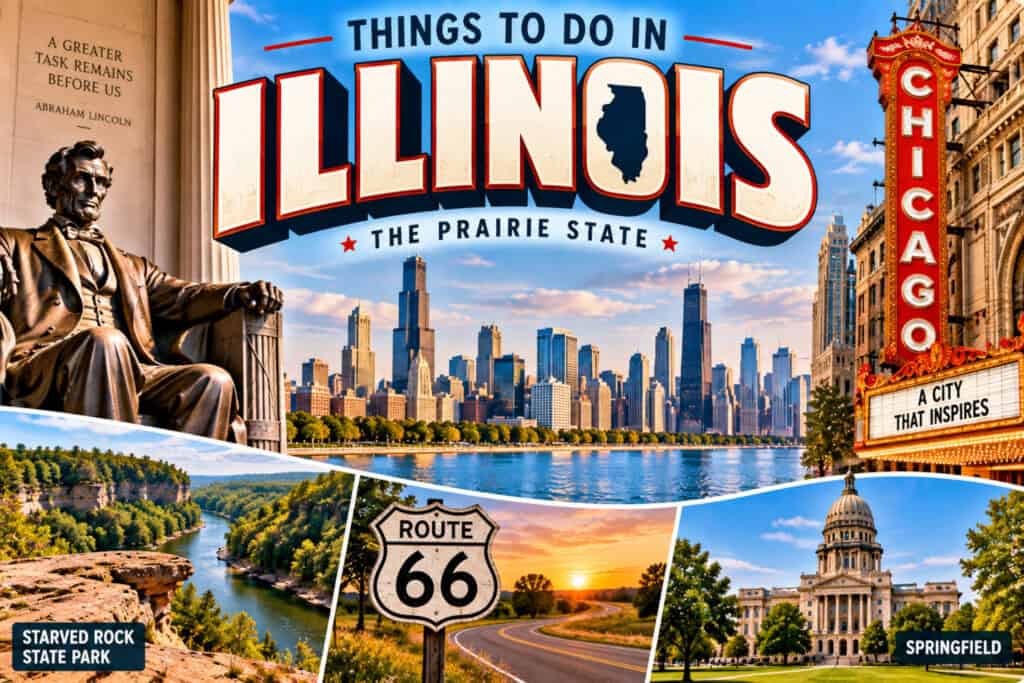
Illinois is worth a 2026 trip anyway. It just needs a look at the current notices before each day gets locked in. Geography does the rest of the deciding. Chicago can fill several days by itself.
Starved Rock and the Illinois River Valley work as an outdoor break from the city. Springfield is the state's strongest history stop.
Galena and the Mississippi River bluffs feel like a separate small-town getaway, while southern Illinois is another trip again, built around sandstone cliffs, forest roads, and the Shawnee National Forest.
A first-time visitor who tries to combine Chicago, Galena, Springfield, and Garden of the Gods in one short weekend will spend most of it in the car.
Pick one or two regions instead, and build around the experiences that are hard to replace anywhere else.
The best things to do in Illinois at a glance
| Experience | Best for | Where | Time to allow |
|---|---|---|---|
| Chicago architecture river cruise | First-time Chicago visitors | Chicago | About 2 hours including boarding |
| Millennium Park and the lakefront | Free sightseeing, families | Chicago | 1-3 hours |
| Art Institute of Chicago | Art and rainy-day plans | Chicago | 2-4 hours |
| Pullman National Historical Park | Labor and industrial history | Chicago | 1-3 hours |
| Starved Rock State Park | Canyons, bluffs, waterfalls | Illinois River Valley | Half day to full day |
| Matthiessen State Park | More rugged canyon hiking | Illinois River Valley | 2-4 hours |
| Lincoln Home | Lincoln history | Springfield | 1-2 hours |
| Abraham Lincoln Presidential Museum | Museums, history | Springfield | About 2.5 hours |
| Illinois Route 66 | Road trips, Americana | Chicago to the St. Louis area | 1-5 days |
| Galena Main Street | Small-town weekends | Northwest Illinois | Half day to weekend |
| U.S. Grant Home | Presidential history | Galena | About 1 hour |
| Great River Road | Scenic driving | Western Illinois | Half day to several days |
| Cahokia Mounds | Archaeology and Indigenous history | Collinsville | 1.5-3 hours |
| Garden of the Gods | Big views, short hikes | Southern Illinois | 1-3 hours |
| Giant City State Park | Hiking and a longer Shawnee stay | Southern Illinois | Half day |
1. See Chicago from the river
For a first trip to Chicago, an architecture cruise is one of the rare tourist standards that earns its place near the top of the list.
The Chicago River puts you at the base of towers that are hard to read from street level, and a good cruise turns the skyline into a sequence: early commercial buildings, Art Deco landmarks, modernist towers, engineering decisions, and newer additions that changed the riverfront.
The Chicago Architecture Center's version runs about 90 minutes and is led by trained volunteer docents.
Its practical value is the mental map.
You spend an hour and a half learning what you are looking at, then walk the Riverwalk, Michigan Avenue, and the Loop while the buildings are still fresh.
If architecture is a major reason for the trip, pair the cruise with the Chicago Architecture Center itself rather than stacking another observation deck on top of it.
2. Walk Millennium Park and continue to the lakefront
Millennium Park works best as the opening of a downtown walk.
Start with Cloud Gate, the Jay Pritzker Pavilion, and Lurie Garden, then continue south toward the Art Institute or east toward the lake.
The surrounding park system connects public art, skyline views, gardens, and Lake Michigan without a car.
It is also one of the simplest free things to do in central Chicago, which makes it useful on an arrival day, between museum visits, or when the weather is too good to spend the whole afternoon indoors.
Summer concerts and events change how the park feels from one day to the next, so the city calendar is worth a look during festival season.
3. Give the Art Institute enough time
The Art Institute of Chicago can absorb an entire day, and squeezing it into the hour before dinner wastes the ticket.
Most visitors do better choosing a few departments than trying to cover everything.
The museum is especially strong for Impressionist and Post-Impressionist painting, American art, European painting, decorative arts, photography, and modern and contemporary work.
Pick three or four priorities before you walk in, spend two to four hours inside, then leave before fatigue turns the last galleries into a blur.
The museum pairs naturally with Millennium Park, since the Modern Wing sits on the park side of the campus.
4. Add Pullman if Chicago history matters more than another viewpoint
Pullman National Historical Park is one of the best ways to make a Chicago itinerary less predictable.
The neighborhood holds several connected stories: industrial planning, the Pullman Company, labor conflict, rail travel, and the Pullman porters whose work became central to Black labor history.
Much of the experience is the neighborhood itself rather than a room with exhibits in it.
Start at the National Park Service visitor center.
The park also runs ranger programs and offers a self-guided experience through the NPS app.
Pullman is still a living neighborhood with private residences, so a slower walk suits it better than a checklist.
For travelers who want to understand how Chicago's industrial growth shaped everyday life, this beats one more downtown attraction.
5. Hike Starved Rock, but check the 2026 trail notices first
Starved Rock State Park is the obvious outdoor day trip for many Chicago visitors, and it deserves the attention.
The landscape is built around sandstone canyons, bluff trails, wooded ravines, and overlooks above the Illinois River.
Access is the part that needs planning this year.
Illinois is carrying out a major trail-improvement project, so some trails may be closed or limited while work is underway.
The visitor center, lodge, and campground remain open, and the hiking menu is what shifts.
So the route is not something to lock in weeks ahead: read the park's current trail notice shortly before leaving, then choose a loop around what is actually open.
Waterfalls answer to recent rain.
A canyon that looks dramatic after a storm can be nearly dry after a long spell without one.
Arrive early on fair-weather weekends, and treat the overlooks, canyons, river scenery, and forest as the core of the day rather than planning everything around one specific waterfall.
6. Use Matthiessen as a separate canyon hike, not just a Starved Rock overflow lot
Matthiessen State Park sits close enough to Starved Rock that visitors often combine the names, and the hiking is a different animal.
The Dells area takes hikers in among narrow rock walls, stairways, creek crossings, and waterfall terrain.
Some routes are more physically involved than the broad bluff trails next door, especially when the surfaces are wet.
Current conditions matter here too.
In 2026, Illinois has posted closures and detours affecting parts of the park, including the Lake Falls bridge area, and the Dells and Vermilion River areas can hit parking capacity on busy warm-season weekends.
Hiking both parks works best with a separate half day for each.
With only one day available, take Starved Rock for the classic overlooks and Matthiessen for the enclosed canyon walk.
7. Tour the Lincoln Home in Springfield
Springfield is where Illinois history gets personal.
The Lincoln Home National Historic Site preserves the house and surrounding neighborhood where Abraham Lincoln lived before becoming president.
Entry to the house is by ranger-led tour only, and the tickets are free.
The catch is that those tickets are issued for timed tours and can run out on busy days, particularly during the heavier March-through-November season.
Arriving earlier gives you a better choice of tour time, and arriving late can mean no interior tour at all.
Do not leave straight after the house.
The surrounding four-block historic neighborhood is part of the site, and the National Park Service recommends allowing roughly two hours to experience it rather than only walking through the home.
8. Pair the Lincoln Home with the presidential museum
The Abraham Lincoln Presidential Library and Museum is the natural second half of a Springfield history day.
The Lincoln Home is intimate and place-based; the museum carries the broader story of Lincoln's family, political rise, presidency, the Civil War era, and public memory.
The institution says most visitors spend about 2.5 hours inside.
As of September 2026, the museum is open daily from 9 a.m. to 5 p.m., with last admission at 4 p.m. Advance ticket purchase is encouraged.
Two blocks of time is the whole shape of a strong Springfield day: the Lincoln Home and its neighborhood, lunch or a downtown walk, then the museum.
9. Drive part of Route 66 during its centennial year
Illinois has an unusually good reason for a Route 66 trip in 2026, because the road is marking its 100th anniversary.
The historic route begins in Chicago and runs southwest through communities including Joliet, Pontiac, Springfield, and towns closer to the St. Louis area.
Illinois tourism promotes a 301-mile corridor, with roadside museums, murals, old service stations, giant fiberglass figures, diners, and automotive history.
The route works at three scales. A Chicago visitor can find the historic starting point and add a nearby stop.
A central Illinois trip can combine Pontiac and Springfield.
A dedicated road trip can follow the corridor for several days.
Treating every roadside attraction as equally important is what ruins it.
Choose a few stops that match your interests, leave time for the road itself, and check the centennial events calendar to see whether something overlaps your dates.
10. Spend a slow day on Galena's Main Street
Galena is one of Illinois' strongest weekend destinations because the town itself is the attraction.
Main Street runs through a dense historic district of 19th-century commercial buildings now filled with shops, galleries, restaurants, and small businesses.
The pleasure is walking it without a fixed sequence, then branching into the town's Civil War and presidential history.
Galena also works as a base for a broader northwest Illinois trip.
The surrounding hills, Mississippi River country, wineries, winter recreation, and scenic drives keep it from being only a shopping stop.
For couples or anyone who wants a low-pressure weekend, it beats forcing another museum-heavy city break.
11. Visit Ulysses S. Grant's home
Galena's U.S. Grant Home State Historic Site gives the town's presidential history a physical center.
The house was presented to Grant after he returned to Galena as a Civil War hero in 1865, and it stayed connected to the family through his political career and presidency.
It sits close enough to Main Street to fit into a half-day history loop.
State hours vary by season, running longer from March through October and shorter from November through February.
Check the site's schedule before building a day around a specific tour time.
12. Follow the Great River Road for bluffs, river towns, and detours
The Great River Road follows the Mississippi along Illinois' western edge, and it behaves like a corridor rather than one scenic drive.
A northern version can center on Galena and the river bluffs.
Farther south, the road links small towns, historic sites, locks and dams, birding areas, and eventually the St. Louis-area attractions on the Illinois side.
This is the part of Illinois that rewards stopping without a schedule.
A river overlook, a historic district, a local museum, or an old roadside landmark can matter more than covering a set number of miles.
For a short trip, pick one section.
The Illinois byway runs for hundreds of miles, so trying to drive the whole Great River Road in a day gets you the road and none of the towns.
13. Climb Monks Mound at Cahokia Mounds
Cahokia Mounds is one of the most important places in Illinois and one of the easiest to under-plan.
The site preserves the remains of the large Indigenous city that developed here centuries before European colonization, and the earthworks, including Monks Mound and the Grand Plaza landscape, read as parts of an urban and ceremonial system once you know what you are standing in.
Knowing that is harder in 2026, because the main Interpretive Center is closed for renovation until further notice.
The grounds stay open from dawn to dusk, visitors can still walk Monks Mound and the trails north of Collinsville Road, and the site provides a mobile augmented-reality tour.
With the building shut, reading background material before arrival or using the digital interpretation carries much more weight than it normally would.
Cahokia fits especially well into a St. Louis-area itinerary, since it sits on the Illinois side of the metropolitan region.
14. Walk the Garden of the Gods Observation Trail
Garden of the Gods is the visual argument for making a separate trip to southern Illinois.
The short Observation Trail reaches exposed sandstone formations and broad views across the Shawnee Hills.
The U.S. Forest Service describes it as a quarter-mile interpretive route with short steep grades and steps, which puts it within reach of most casual visitors while leaving cliff edges that deserve attention.
The larger recreation area connects to a much broader trail system, so the famous overlook can be a quick stop or the start of a serious hiking day.
Sunset is tempting, though arriving at the last possible moment is a poor plan.
Rocky edges and uneven surfaces get much less forgiving as visibility drops.
With time for only one southern Illinois landscape, take this one.
15. Add Giant City State Park for a fuller southern Illinois trip
Garden of the Gods supplies the postcard.
Giant City State Park supplies the rest of the itinerary, with forest trails, sandstone passages, bluffs, cabins, and a historic lodge, and trail hours generally running from morning until dusk.
It suits travelers who want more than one short scenic stop in the Shawnee region.
A two- or three-night southern Illinois trip can combine Garden of the Gods with Giant City, other Shawnee National Forest trailheads, and the small communities around the forest.
That holds together far better than bolting southern Illinois onto Chicago or Galena.
When to visit Illinois
There is no single best season, because the regions behave differently.
Spring is good for city sightseeing and canyon hiking, although wet trails can be slippery and water levels can alter access.
Waterfalls at Starved Rock and Matthiessen are often more interesting after periods of rain.
Summer brings long days, Chicago festivals, lakefront activity, and the busiest outdoor weekends.
Heat and humidity become more important in southern Illinois, while popular parks can fill their parking areas early.
Fall is one of the strongest seasons for Galena, the Great River Road, Starved Rock, and Shawnee.
Foliage also brings weekend crowds.
Winter favors museums, Chicago cultural trips, holiday travel, and quieter historic sites.
Snow and ice can change trail conditions quickly, and some seasonal businesses reduce hours.
How to choose the right Illinois trip
For a first Illinois trip, base yourself in Chicago for three or four days.
Prioritize an architecture cruise, Millennium Park, the Art Institute, neighborhoods, and the lakefront, then add one specialized history stop such as Pullman if it matches your interests.
For Chicago plus nature, combine the city with Starved Rock and Matthiessen.
The Illinois River Valley is close enough to work as a dedicated day or an overnight extension, with the current trail closures checked before you leave.
For history and road-trip nostalgia, build around Springfield and Route 66.
The Lincoln Home, the presidential museum, Pontiac, roadside landmarks, and the centennial events fit together naturally.
For a relaxed weekend, choose Galena and northwest Illinois.
Main Street, the Grant Home, river scenery, and the Great River Road make a compact trip without Chicago's pace.
For the strongest outdoor trip, go straight to southern Illinois.
Garden of the Gods, Giant City, and the broader Shawnee National Forest deserve their own itinerary rather than a distant side trip.
What is still unfinished
Three of the sites above are in the middle of work this year: the trail project at Starved Rock, the closures around Matthiessen's Lake Falls bridge, and the Interpretive Center at Cahokia, which is shut until further notice.
None of them closes a destination outright.
Each one moves the good part of the visit somewhere else, onto whichever loop is open, onto the mounds and the trails instead of the exhibits.
The centennial runs on the same principle from the other direction.
Route 66 in Illinois is a corridor of independent museums, diners, and roadside landmarks, and the centennial events calendar is what tells you whether anything is happening on your dates.
So the last planning step for an Illinois trip in 2026 is a short one.
Open the official page for whichever site the day depends on, see what is open this week, and let that decide the route.
The links below are those pages.
Sources and further reading
- Enjoy Illinois - official Illinois travel guide
- Chicago Architecture Center - river cruise information
- Illinois Department of Natural Resources - Starved Rock State Park
- Illinois Department of Natural Resources - Matthiessen State Park
- National Park Service - Lincoln Home National Historic Site
- Abraham Lincoln Presidential Library and Museum - plan your visit
- Illinois Route 66 Centennial - Enjoy Illinois
- Illinois Department of Natural Resources - Cahokia Mounds
- U.S. Forest Service - Shawnee National Forest recreation
- Illinois Department of Natural Resources - U.S. Grant Home